
When all the parts in a set unite to perform the same melody simultaneously, it necessarily results in consonances of unison or octave (*). In other words, there’s a lack of harmony. This process, often used in free composition, has a great effect when the character of the pattern lends itself to it.
(*) The consonance of the octave is also called antiphony, as opposed to homophony, which means consonance of unison. These denominations come from the Greek.
These melodic passages are generally called Passages in Unison, as the octaves only occur due to the limits of the natural range of the various parts.
But this process may be modified by using it without suppressing the harmony. Depending on the number of parts, one can sometimes double, triple, quadruple, in unison, or different octaves, one or more melodies of a harmonic set.
This way of writing has nothing to do with forbidden octaves (CH. 2.6) which are ignorant, and whose hollow effect reveals poverty [in harmony.]
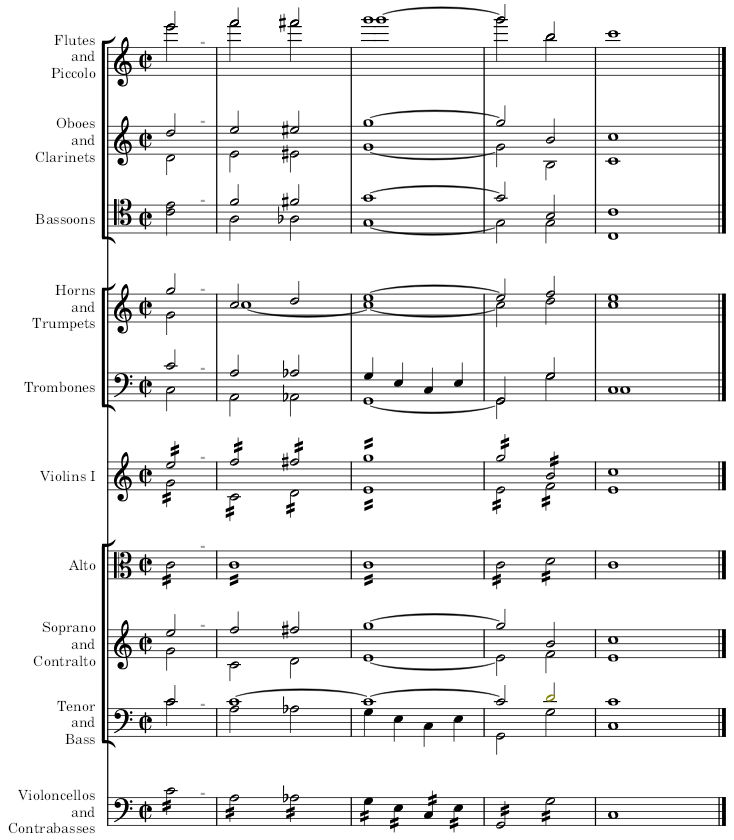
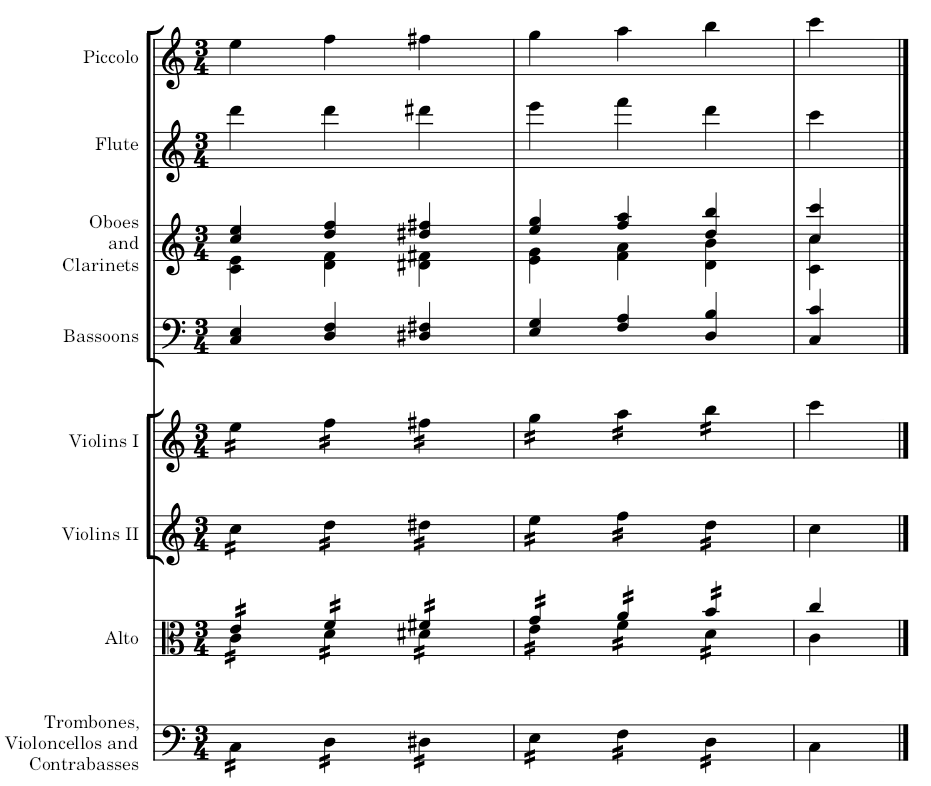
When doubling a melody in octaves or unison within a phrase or passage, its done with the intention of strengthening it or making it stand out, and one considers it only as ONE REAL PART throughout all the parts that perform the same melody, albeit at various octaves or in unison.
When writing for masses (like choir and orchestra), and no single part particularly predominates, we double each real part so each part is roughly the same, with preference of reinforcing the Bass instead of the upper or intermediate parts.
Example of four real parts
Example of three real parts

Example of two real parts
But a part can only be doubled when the result has no fault in harmony. So in the following example:
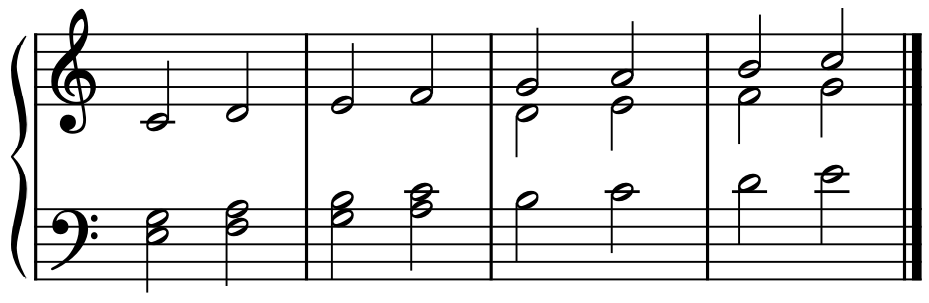
The middle part cannot be doubled in octaves above because it would result in a series of fifths:
Examples:

etc.

etc.
It’s also faulty to double a part in octaves when ninths result below or next to their root (CH. 15.1), thirds above the major ninth (CH. 15.1), diminished thirds (CH. 17.1), and unprepared or unresolved fourths in the event the doubled part matches with the Bass (CH. 18.1).
 Old Music Theory