
Harmony in two parts is the principal domain of counterpoint. Yet, one can write in two parts without applying the rigorous rules of counterpoint. This is why its absolutely necessary to outline some general principles to guide this kind of work.
The correctness of the realization is more necessary in two parts than in three or four parts.
Guideline #1: Similar movements should never lead to a perfect fifth, an octave, or a unison, even when the upper part proceeds by adjacent degrees and the lower part by disjointed degrees. The dominant chord is almost the only exception to this rule:
Example:
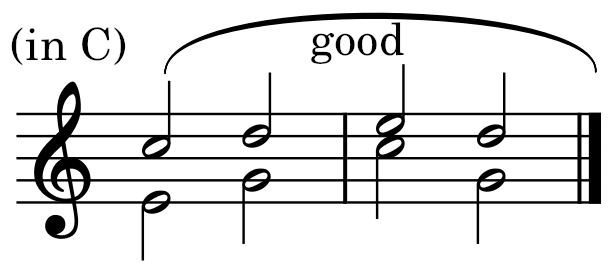
Guideline #2: In general, similar movement is practiced only in thirds (major and minor) and sixths (ibid.); all other intervals must come by opposite or oblique movement, as much as possible.
Guideline #3: Delayed fifths and octaves (CH 5.2) whenever and however they appear in a measure, have a bad effect in two-part harmony.
Guideline #4: Perfect fourths are generally avoided. If, however, this interval is used, it must be prepared and resolved. The following cadence formula is tolerated:
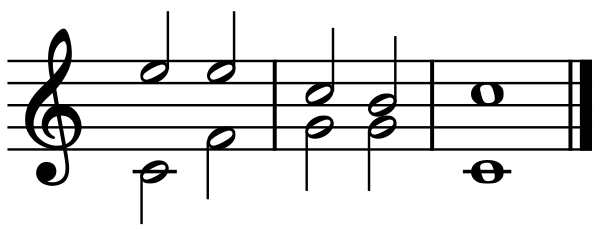
As for the analysis of two-part harmony, it can often result in various interpretations, as the consonances of octaves, thirds, sixths, aren’t always formed by the important notes of the implied chords.
However, all incomplete chords are classified by the ear as the degree it is accustomed to hear in the most used formulas, in other words, the ear always leans towards the best possible degree (CH. 12.1).
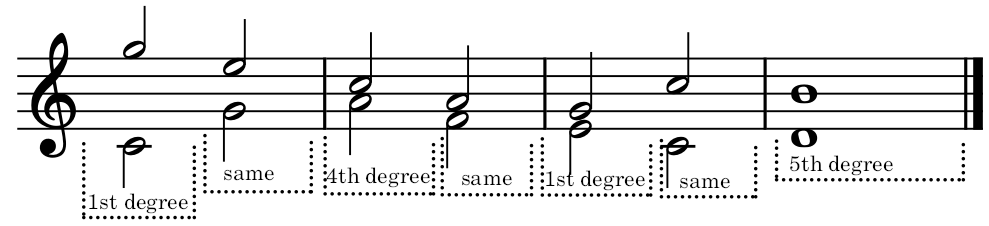
So, the following example may include numbers that are placed above the bottom:
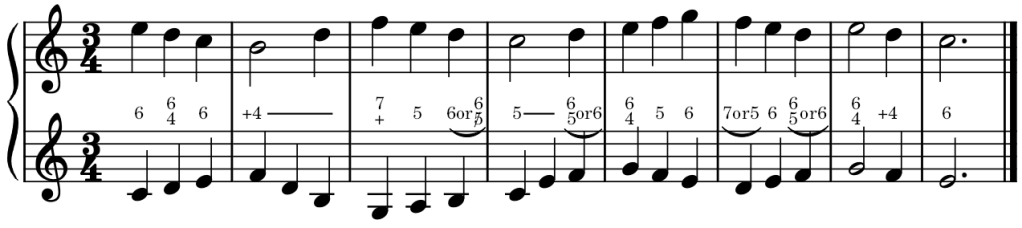
 Old Music Theory