
A chord is the simultaneous emission of several different sounds.
The basic structure of all chords consists of a set of three, four, or five different sounds all belonging to the same scale stacked in intervals of thirds. Examples:

This is the law for forming chords for the entire harmonic system. In this arrangement of stacked thirds, the lowest note is called the root or fundamental of the chord. The other notes of the chord are named based on the interval they form with the root note. Thus, the G chord, besides its root (G), is composed of the third (B), the fifth (D), the seventh (F), and the ninth (A). Regardless of the order and place of the notes, they all retain the name of their simple interval in the basic arrangement of the chord. In other words, the root is always referred to as the root even when its place above the other notes of the chord. The same is true for the third, fifth, etc.
The chord itself is always named based on its root.
If the notes of the following chord:
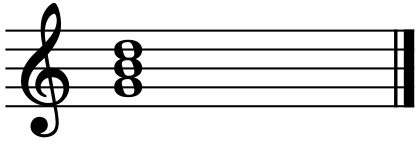
are arranged thus:
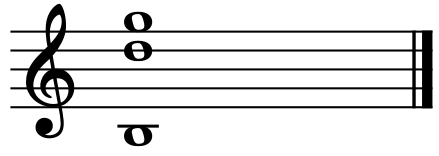
or any other way, the chord is still a G chord, because the G note is always the root, the B is the third, and the D is the fifth of the chord.
Therefore a chord, in the strict sense of the word, means a simultaneous combination of various notes, regardless of the order they’re placed, must be able to be rearranged in the state of stacked thirds.
The stacked notes, in order of thirds, form the constituting notes of a chord, also known as the integral notes or real notes.
Any group of notes that can’t be stacked in thirds or contains more than five different sounds belongs to one of the following categories:
- The group is inadmissible and is unpleasant or confusing to the ear
- The group, while pleasant to the ear, contains one or more notes that aren’t apart of the actual chord.
These non-chord notes are called foreign notes or accidental notes. The are focus of the second book (Part 3 and 4).
Among this second category, there are certain note groups also referred to as chords. While this term is technically incorrect, its called as such due to custom and tradition. Therefore, by extension, we can apply the word chord to any harmonic combination having a certain duration.
 Old Music Theory