
An interval is the distance from one note to another.
An interval is harmonic when the notes are heard simultaneously. Its melodic when the notes are heard successively. Example:

A harmonic interval is normally identified based on the distance from the lowest note. A melodic interval is ascending when it goes from low to high (Ex. A), and descending when it goes from high to low (Ex. B.)
The interval is simple when its distance is less than an octave, and composed or redoubled when its greater than an octave. Example:
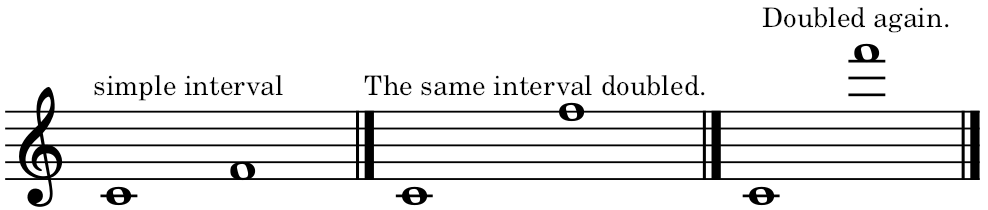
Table of Simple Intervals
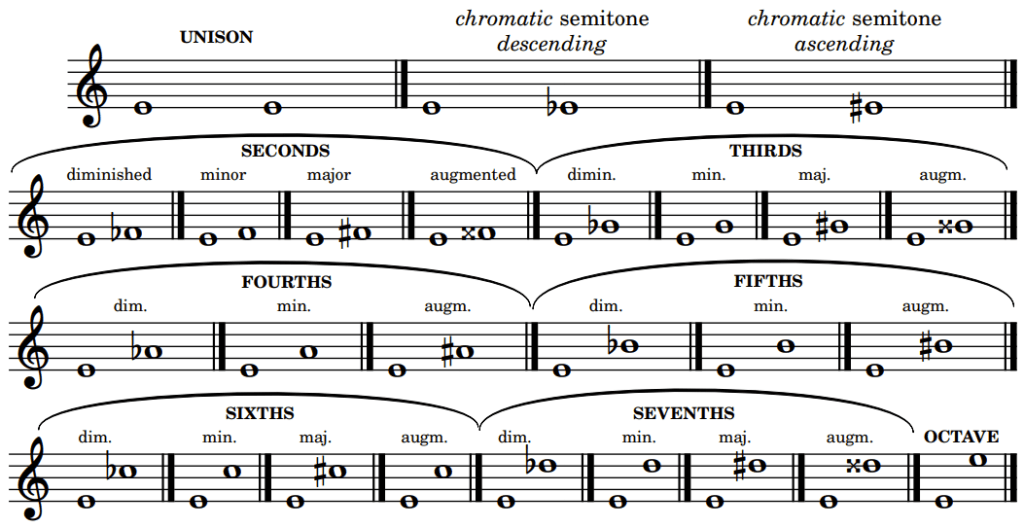
Note: the diminished second, is often called enharmonic or an enharmonic interval. The same with its inversion, the augmented seventh.
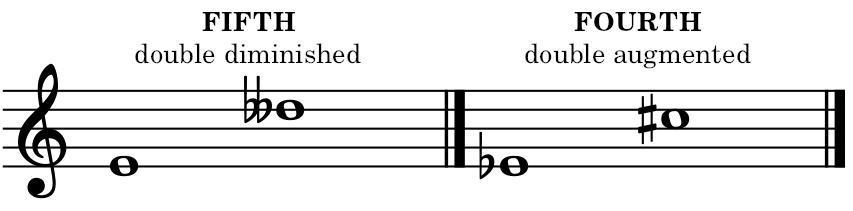
When a diminished interval is decreased by a semitone, or an augmented interval is increased by a semitone, they become double diminished or double augmented. Example:
The doubled/redoubled intervals generally have the same name as their corresponding simple intervals. However, we often need a more precise name for the distance of doubled intervals.
Thus, a doubled second is called a ninth. The third, fourth, fifth, etc. doubled are called the tenth, eleventh, twelfth, etc.
The ascending chromatic semitone when doubled is called an augmented octave. The descending chromatic semitone, transposed to the octave above is called the diminished octave.
Inverting intervals is when the lower note is transposed one or more octaves above the upper note (Ex. C), or the upper notes is transposed one or more octaves below the lower note (Ex. D.)

The quality of an interval is changed by the inversion. Thus:
- minor becomes major, and vice versa.
- diminished becomes augmented, and vice versa.
- The perfect fourth becomes a perfect fifth, and vice versa. The perfect fourth and perfect fifth are the only intervals whose inversion doesn’t change its quality. They are both perfect.
Consonances (or consonant intervals) are the unison, octave, perfect fifth, major/minor third, and major/minor sixth. These intervals are often further classified as:
- perfect consonant intervals which are: unison, octave, perfect fifth.
- imperfect consonant intervals which are: major/minor third, major/minor sixth.
All other intervals are dissonant, except for the perfect fourth, which isn’t classified as a consonant nor a dissonant interval. In other words, its sometimes consonant, sometimes dissonant, according to the conditions it placed in. These conditions will be explained in the chapter on chord inversion. For now, we will consider the perfect fourth as consonant.
 Old Music Theory