
Consists of a perfect major chord with the addition of a minor seventh. Its placed on the dominant (5th degree) of the two modes, which is why its called the Dominant Seventh Chord.
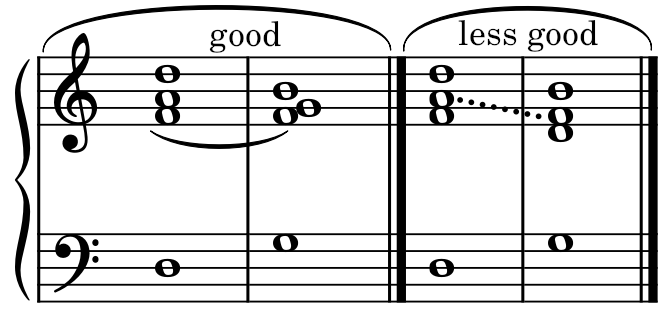
The seventh or dissonant note of this chord requires no preparation, but if this note is common with the previous chord, its best to prepare it.
Examples:
The 3rd of the chord, the leading tone of the scale, must rise to the tonic note. This is a pronounced resolutive tendency of this chord. However, like the dissonant note, it can resolve by remaining in place or undergoing a chromatic or enharmonic change.
The following table contains the dominant seventh chord with its inversions and natural resolution, and the manner of figuring it.
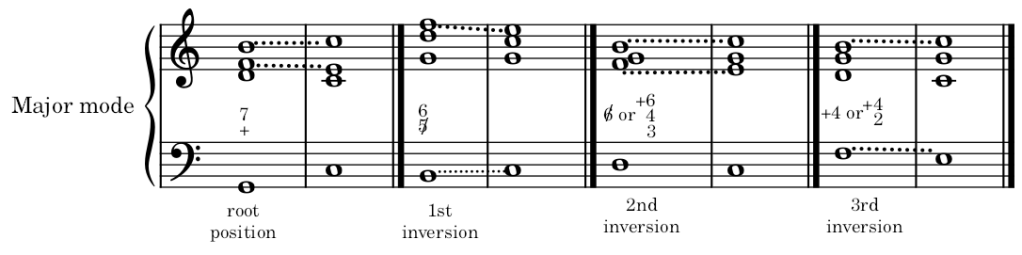
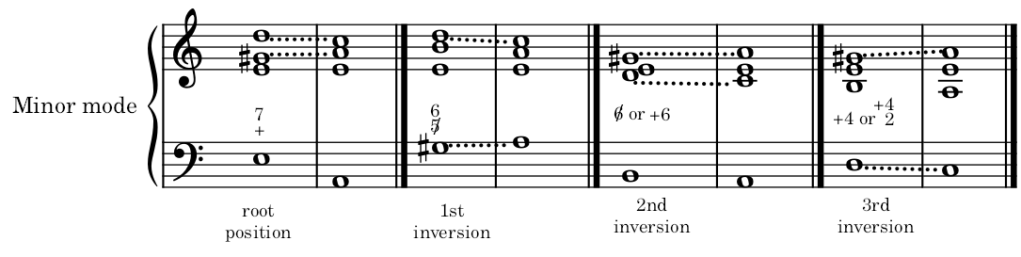
Note: The figuration above is generally adopted for the seventh dominant chord as it does not require any indication of accidentals that modulations require, in any circumstance and invention.
The six bar, 6, figuration of the second inversion is quite conventional.
The little cross, +, serves exclusively to indicate the leading tone in all dominant dissonant chords. In the root position, the little cross is placed above the root and represents the third, as would any isolated accidental, as if the chord was figured 7 +3. The second inversion, in many schools, is +6 instead of six bar.
The dominant chord, with or without the seventh, sometimes allows the suppression of the third. This suppression is done according to melodic convenience or an insufficient number of parts. Example:

Its only in the second inversion where suppressing the third is avoided.
Basses to Realize


Main Exceptional Resolutions of the Dominant Seventh Chord
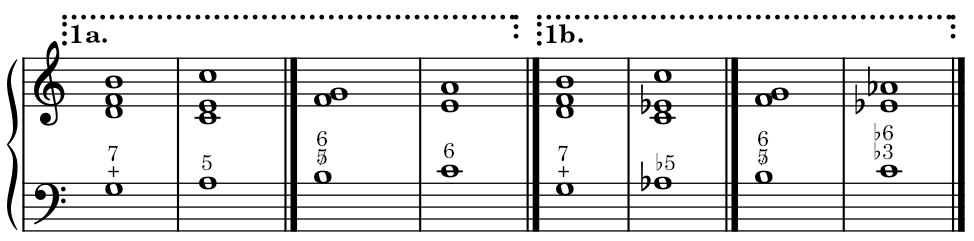

(*) The fourth of the second dominant seventh is not resolved, but this exception has a good effect.


(**) The exceptional resolution here is the chromatic of the leading tone (normally, it resolves to tonic note.)
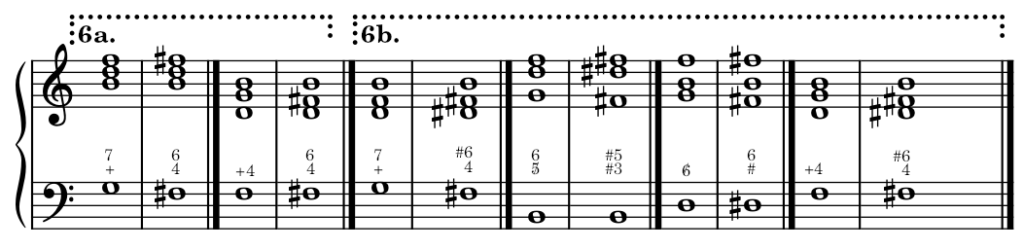
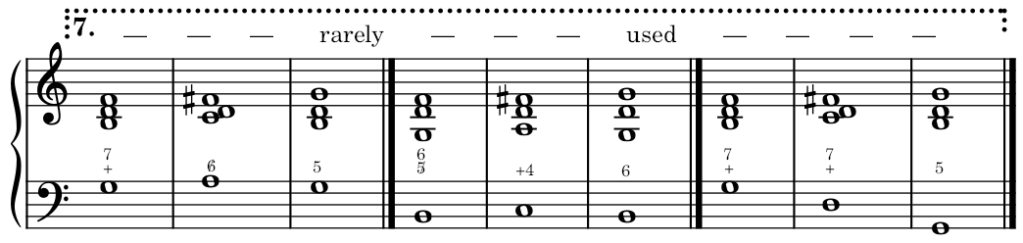
NOTE: The dominant seventh chord has more exceptional resolutions aside from the ones listed, but they lead to chords that will be discussed later.
Commonly Used Exceptional Resolutions
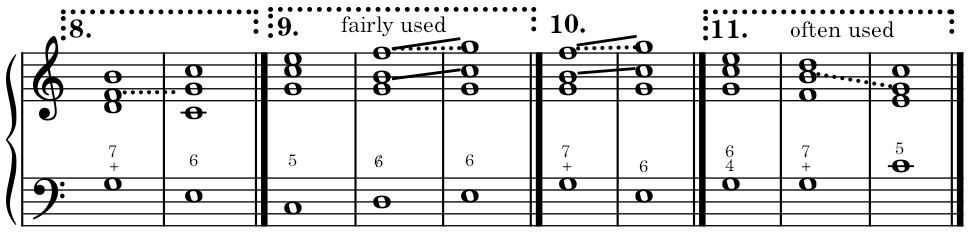
NOTE: Ex. 9 and 10 contain consecutive fifths, which are not harsh because of the influence of the first inversion (7.1.)
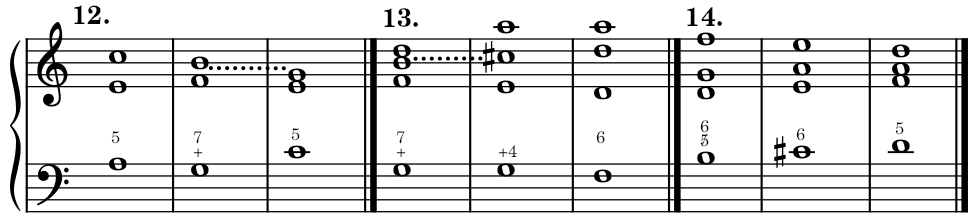
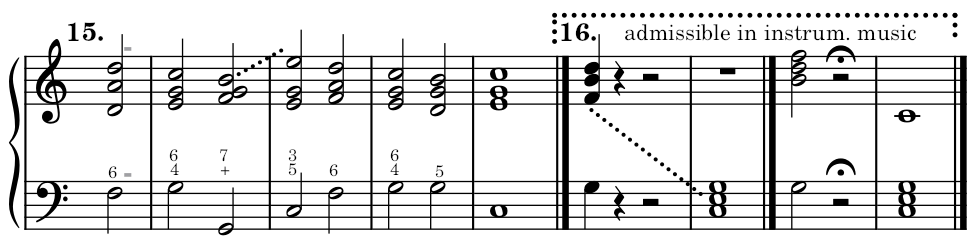
Observation: Many modern authors have often ignored preparing and solving the fourth in the second inversion of the dominant seventh chord. For students, this exception is only to be used when resolving the first chord, similar to the example in 2a. marked with (*).
Regarding the ability to move the notes by stepwise motion during the duration of the dominant seventh chord, see Part II: 1.1 (dissonant notes may be separated from its resolution note by a silence or another integral note of the chord); it goes without saying that this ability applies equally to the leading tone as to the dissonant note.
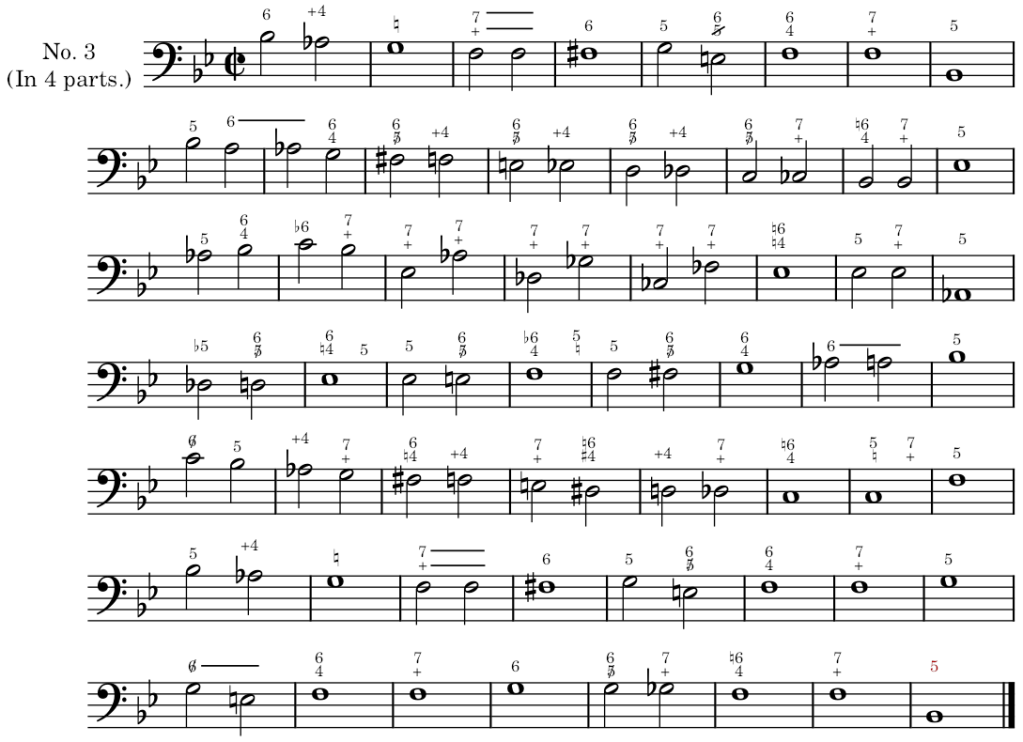
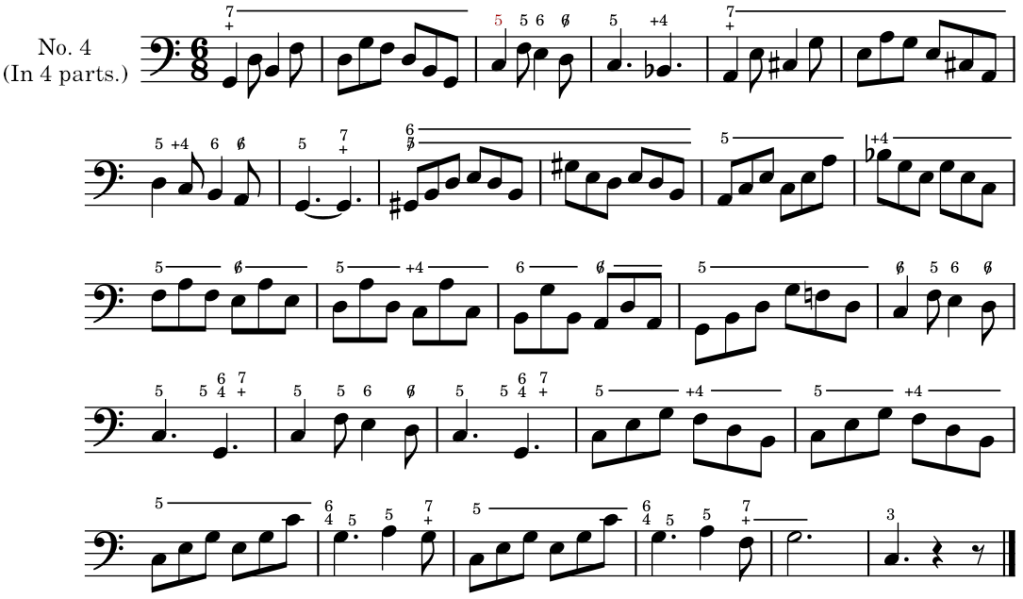
Basses to Realize
Reflections on the Dominant Seventh Chord
The dominant seventh chord is the least dissonant of all dissonant chords. Its abuse in modern music is such that most composers treat the dominant chord (without the seventh) as incomplete, regardless of the character of the piece, implying the dissonance is necessary. Furthermore, its a common erroneous belief that one can only modulate by dissonant chords, especially the dominant seventh chord. Its evident this chord has an undeniable tonal power, since its only found on the dominant of the two modes, and even when struck in isolation it irrevocably determines the tone, if not the mode. But there are many other ways of modulating, as shown in the chapter of modulations. To exclusively use the dominant seventh chord to modulate is to impoverish art by depriving itself of its numerous resources.
 Old Music Theory