
The major seventh chord consists of a perfect major chord with a major seventh.
The major seventh chord is the most dissonant of all seventh chords, so the preparation of its dissonance is a strict requirement. It’s placed on the 1st and 4th degree of the major mode, and on the 6th degree of the minor mode (see Ch. 14). This chord is notated the same as the chords of the previous articles.
Similar to the minor seventh chord and the half diminished chord placed on degrees other than the 2nd (Ch. 14.3), the major seventh chord is used principally in harmonic marches. Thus, a progression without modulation, forming a March of Sevenths, naturally contains the four types of seventh chords as soon as the progression is of a certain length (see Ex. A and C).
Examples of a March of Sevenths.

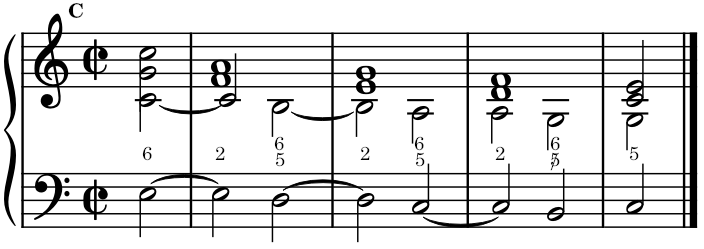
Note: the second inversion is quite unusual (Ch. 13.2).
Exceptional Resolutions
While this chord is mainly used in harmonic marches, its effect can be excellent outside it. The following are the exceptional resolutions:
Table of the main exceptional resolutions of the major seventh chord.
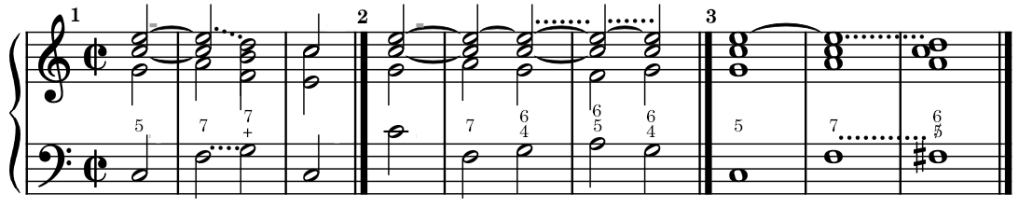
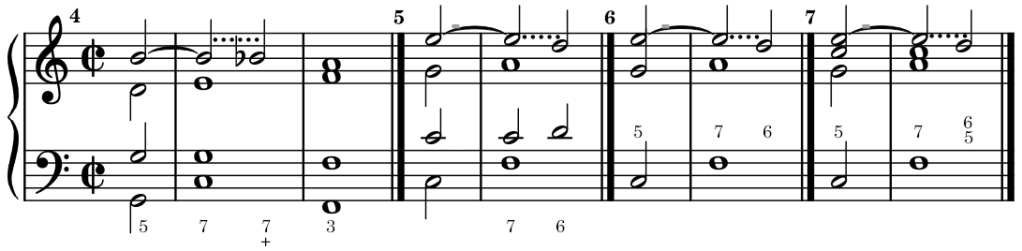
Note: We will see in the chapter on suspensions, that several exceptional resolutions in the preceding table, mostly Ex. 6 and 7, are best analyzed as suspensions.
 Old Music Theory