
The minor seventh chord consists of a perfect minor chord with a minor seventh. Its placed on the 2nd, 3rd, and 6th degree of the major mode, and on the 4th degree of the minor mode (see table in Ch. 14).
The half diminished chord consists of a diminished fifth chord with a minor seventh. Its placed on the 7th degree of the major mode and on the 2nd degree of the minor mode (see table in Ch. 14).
Primary Use of These Chords
The minor seventh chord is used almost exclusively on the 2nd degree of the major mode, and the half diminished chord on the 2nd degree of the minor mode.
These chords serve the same function in their respective modes and they have the same modal and tonal importance. Thus, they are studied simultaneously.
The dissonance of these two chords are required (see 14.1).
The figurations of these chords and their inversions are listed below:
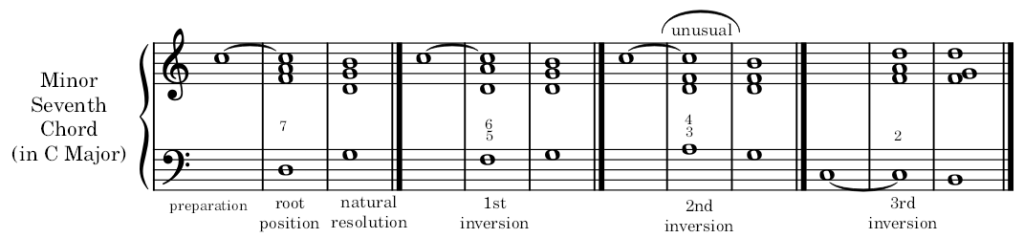
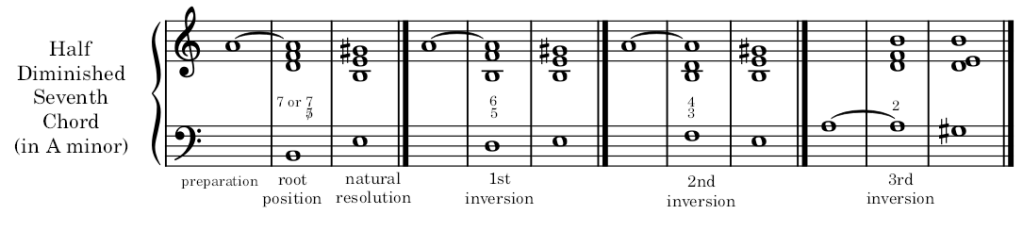
(The student may fill the first chord as practice.)
Note: The figurations for both chords are the same. Thus in modulations, these figures needs the addition of more or fewer accidentals and sometimes additional figures affected by the accidentals.
Exceptional Resolutions
The main exceptional resolutions are as follows:



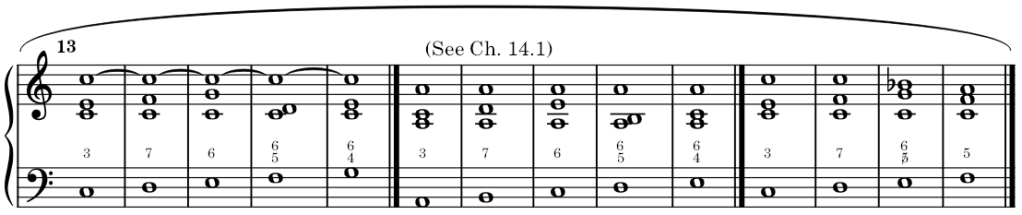
The major mode can borrow the seventh chord of the 2nd degree from its parallel minor, but the opposite never takes place (see 10.6). Examples:

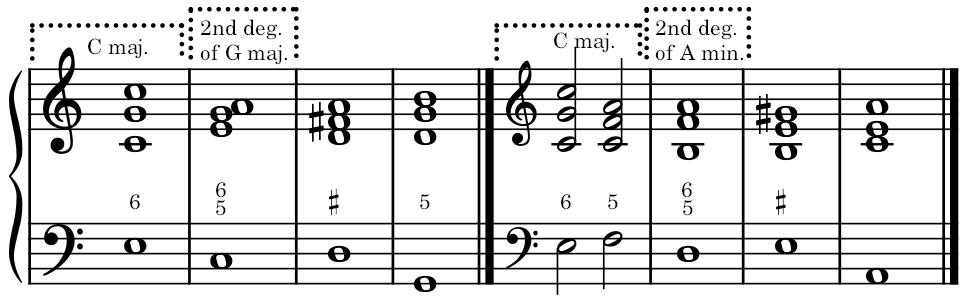
By the habit developed by the ear by constantly hearing these two chords, it follows that both chords have great modal and tonal importance. Thus, they can be used to modulate even without the characteristic note. These chords don’t absolutely determine a modulation, but they provoke it. Examples:
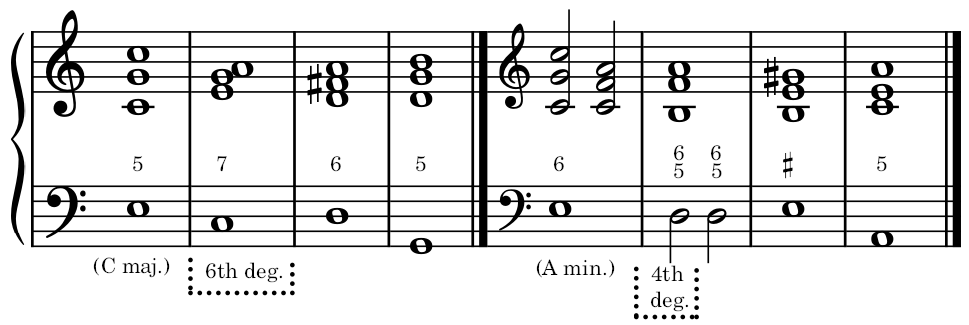
As for the two chords placed degrees other than the 2nd (see Ch. 14), they are generally only practiced in harmonic marches. However, the minor seventh chord on the 6th degree of the major mode, and on the 4th of the minor mode, may be used outside of harmonic marches with a good effect. Examples:
Some authors have sometimes ignored preparing the dissonance of the seventh chords on the 2nd degree of the two modes. This exception is forbidden to the student.
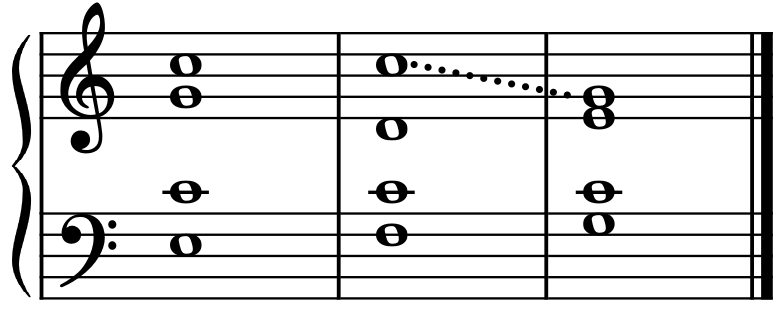
Exceptions for resolving the dissonance of these chords are extremely rare. However, the following example is the common, especially when it occurs in a predominant part and is motivated by the melody. Example:
 Old Music Theory