
By examining the various seventh chords from stacking thirds on each degree of the two modes (see the following table), there are seven types buy only four are true seventh chords based on the principles of the previous chapter.
These principles are not applicable to the seventh chords of the 1st, 3rd, and 7th degree of the minor mode. The seventh chord on the 1st degree of the minor mode is impracticable and is only classified in the part dealing with accidental notes. The 3rd and 7th degree chords of the minor mode have previously been outlined as unusual. Thus, these chords have been crossed out in the table.
Table of seventh chords in the two modes.
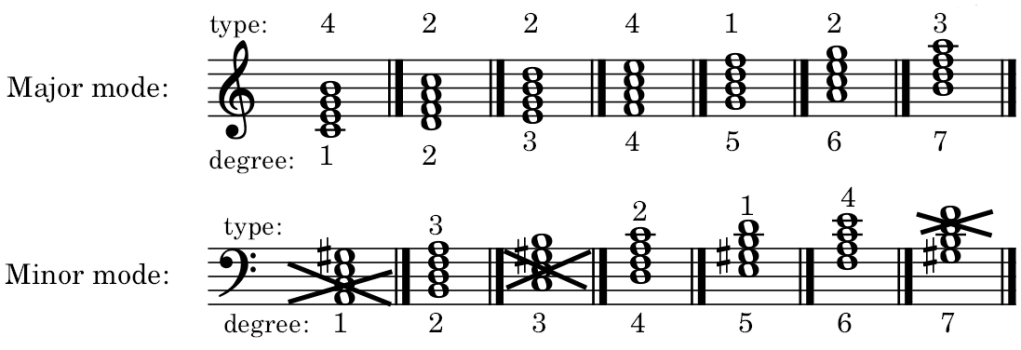
Note: The 3rd and 7th degree chords in the minor mode are used in harmony, but they rarely present themselves with the character of their degree. Their origin is different. The 3rd degree chord will be discussed in altered chords. As for the 7th degree, its derived from the chord of the minor ninth without the root.
Of the seven different species, those placed on the 1st, 3rd, and 7th degree of the minor mode are inadmissible. The seventh chord on the 1st degree of the minor mode is impracticable, and the chord of the 3rd and 7th are unusual.
 Old Music Theory