
In previous articles, we established the altered fifth in chords with a major third as the principle of altered chords. This principle isn’t as arbitrary as one might think. It rests on the tonal influence exerted by every altered chord, an influence confirmed by its natural resolution (17.1), and by its applications by many composers (*).
(*) We’re only discussing alterations of a clearly defined chord. Melodic alterations, due to their brief and unique nature, may seemingly result in dissonant aggregations. This will be explained in further chapters on melodic notes.
However, we cannot ignore the alterations which seem to contradict the definition of altered chords (17.0). Thus, altering the root or third, in certain chords, produces perfectly admissible harmonic aggregations.
But these chords are ambiguous amongst the chords in tables of 17.2 and 17.3.
Anyone can test the effect of these alterations on chords that allow for them, making it easy to identify any ambiguities. Here, we will focus on mentioning the most significant ones:
1. The descending alteration of the root of a perfect minor chord:
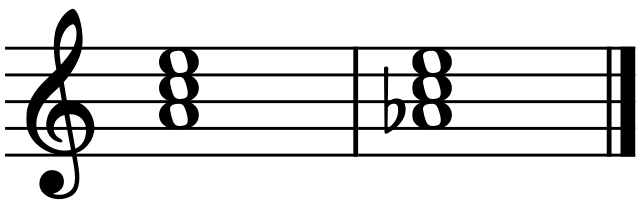
gives a similar result to the augmented fifth of a perfect major chord:

The same descending alteration of the root in a minor seventh chord, produces the seventh chord with an augmented fifth, identical to Ex. 4, 17.2.
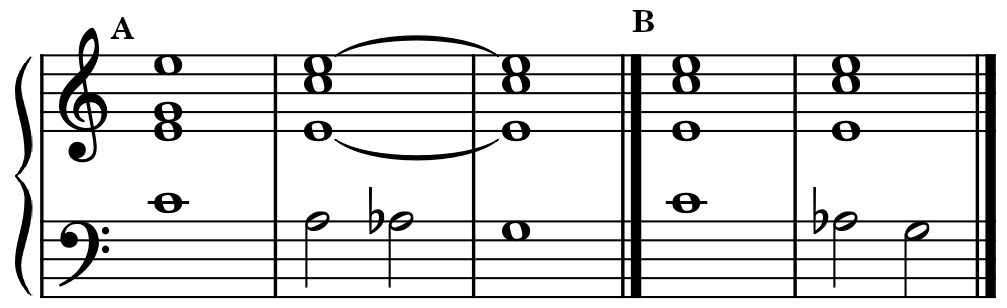
This alteration of the root of perfect minor chords is quite common. But note that it always presented with the character of a melodic alteration. (Proof of this is provided in the study of melodic notes.)(**)
(**) Thus, in Ex. A, the A♭ is simply a passing note; in Ex. B that same is appoggiatura.
2. The augmented sixth chord was formerly regarded as a fundamental chord, whose inversion were impracticable. This explains the caution and hesitancy around the relatively late and recent (late 1800s) use of certain chords, of which the augmented sixth is essentially an inversion of. Many theorists still believe this chord has different origins depending on its use and application.
Thus, the following chord:
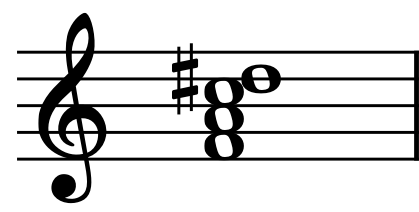
Which originates from the dominant of the dominant of A minor (same as Ex. 21 in 17.2) is sometimes considered as the 2nd degree of C major with an ascending alteration of the root(D), or as the 4th degree of A minor with an ascending alteration of the root(D), or as the 6th degree of F major with an ascending alteration of the root. Lastly, by changing enharmonically changing the D# into E♭:
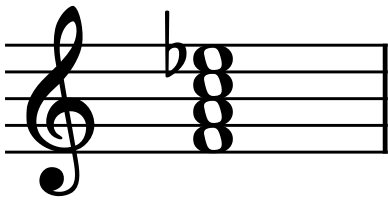
We get the dominant seventh chord in the key of B♭ (*).
In this example:
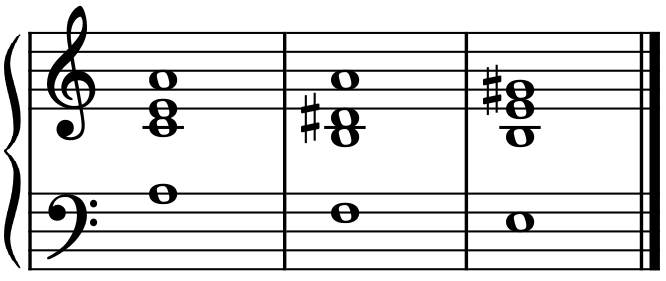
The second chord, like the previously mentioned chord, originates from the dominant of the dominant of A minor, is frequently presented under the appearance of the second inversion of the seventh chord of the 2nd degree of A minor with an ascending alteration of the third. It is completely identical (**) to Ex. 21 of the ascending alteration (17.2).
Moreover, in practice, it doesn’t matter if certain altered chord are written irregularly, such as:
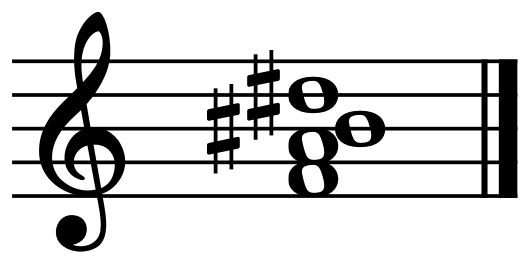
being written as:
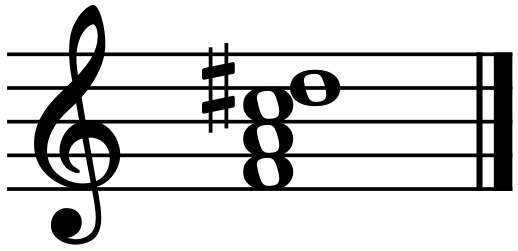
This way of writing is good when it simplifies reading or execution.
In short, regardless of the origin of the various altered chords, the important thing is to know the combinations they can generate, as wells as their effect and application. Practice can, no doubt, lead to this result.
But, theoretically, its preferable to reduce them all to a common principle that gives them a shared origin and subjects them to the same resolution laws that govern other dissonant chords (Ch. 13.2).
By following this principle, the student will always be able to reconstruct the tables from Ch. 17.2 if necessary. They will be able to find, without hesitation, all the resolutions (natural and exceptional) of altered chords.
They will be able to apply these chords in all their forms in practice, and, above all, will never, through ignorance, double a note that, while not an accidental, may turn out to be an altered note.
 Old Music Theory