
The diminished fifth most often applies to the dominant chords of the two modes, especially the dominant seventh chord and the minor ninth chord without the root (diminished seventh chord). Like the augmented fifth, it can apply to tonic chords in the major mode.
With a few exceptions, any chord with a diminished fifth does not need to be preceded by its unaltered chord.
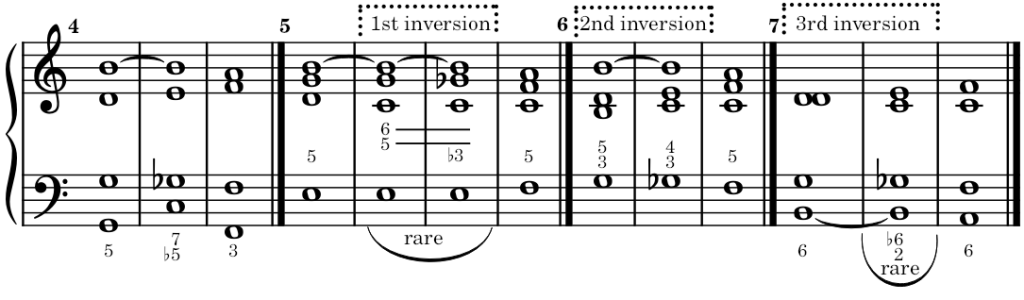
The following tables contain the main chords with a diminished fifth and their natural resolutions.
Tonic Chords
Major chord with a diminished fifth (in C major)
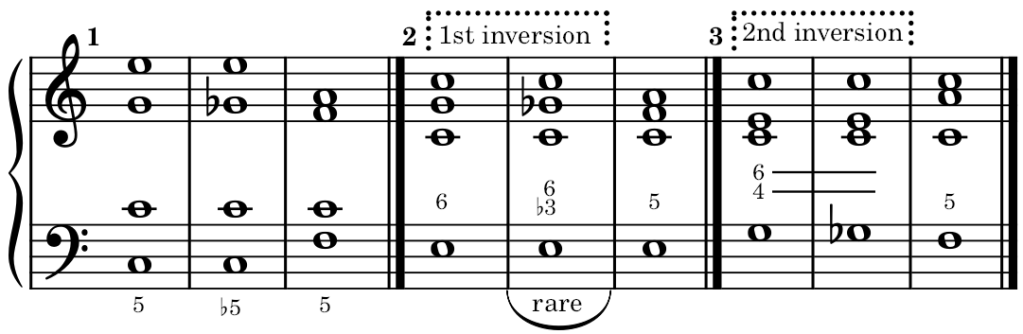
Note: Ex. 2 is in the key of F major, In Ex. 3, the diminished fifth is applied to the 5th degree chord.
Diminished Fifth of the Major Seventh Chord (in C major)
Dominant Chords (*)
Dominant Seventh Chord with a Diminished Fifth
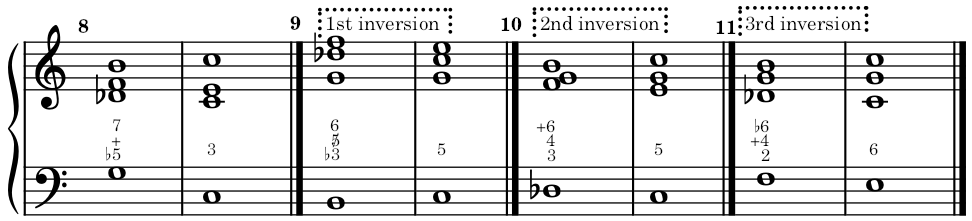
Dominant Seventh Chord with a Diminished Fifth without root
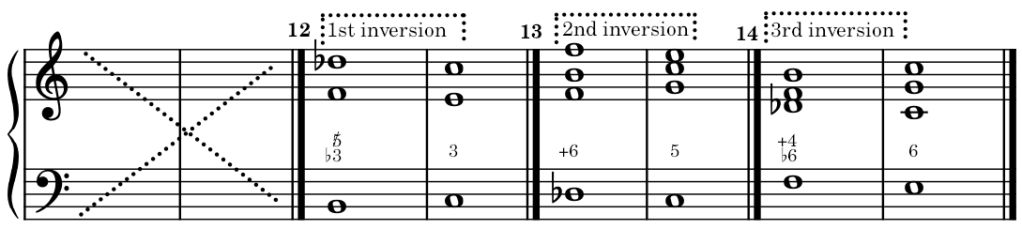
Minor Ninth Chord with a Diminished Fifth
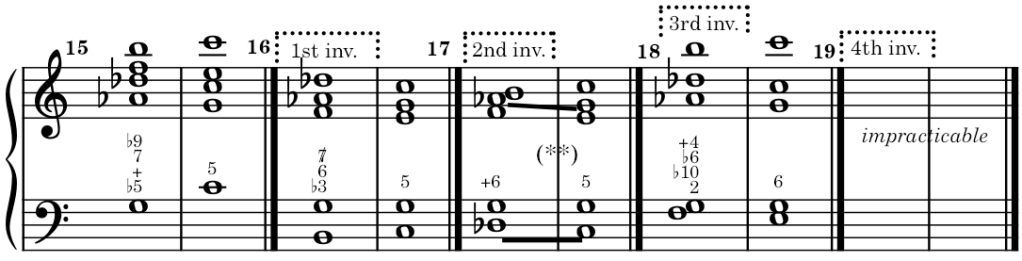
Minor Ninth Chord with a Diminished Fifth without root (Diminished seventh)
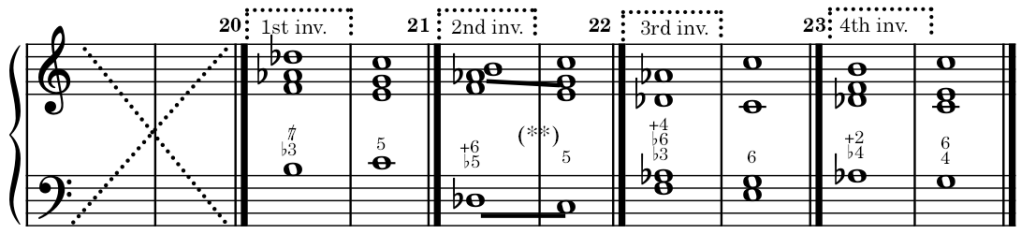
Note: The 2nd inversion of the dominant chord with a diminished fifth is often called the sixth augmented chord.
(*) The small cross on certain numbers in the table can be replaced by a different sign with a key change.
(**) The effect of two parallel fifths by a semitone, somewhat inevitable, is not harsh. It’s better to use this chord in the second inversion only in certain exceptional resolutions which don’t produce these fifths (see Ex. 32).
The major ninth chord with an diminished fifth, even without the root, often produces an extremely harsh effect. Example:
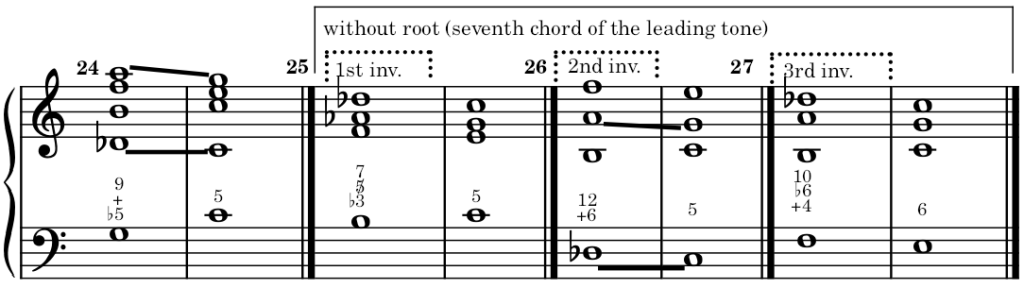
However, we can soften the harshness of this chord by playing the unaltered chord first, or (which in some cases is more preferable) by preparing the ninth. It is in this latter case where the second inversion can produce a very good effect (see Ex. 35).
Augmented Sixth Chord
Regardless of the chord with a diminished fifth, the chord is often in the second inversion. This leads to the altered fifth in the Bass, and with the third in an upper part, it forms an interval of an augmented sixth (see Ex. 3, 6, 10, 13, 17 and 21).
But the term augmented sixth chord is usually understood as the following chords in the second inversion with a diminished fifth: dominant seventh chord (with or without the root), or the minor ninth chord without the root (diminished seventh).
Note: The dominant seventh chord with a diminished fifth without the root is typically referred to as the augmented sixth chord (Ex. 13). However, with the root it is called an augmented sixth chord with an augmented fourth (Ex. 10). Lastly, the minor ninth chord without the root is called the augmented sixth chord with the fifth (Ex. 21). The version in Ex. 13 was the only one accepted by the old composers, the other two are forbidden in the rigorous style.
The other chords, minor ninth with the root (Ex. 17), major ninth without the root (Ex. 26), and major seventh chord (Ex. 6) are omitted in most treaties. Most composers reject or ignore them. As for the second inversion of triads (Ex. 3) its rarely used.
In every augment sixth chord with the fifth in the Bass, results in a fourth. But since its not a perfect fourth, it doesn’t need to be prepared.
By paying close attention to the effect of the diminished fifth on the dominant seventh and ninth chords in the two modes (mainly in the second inversion), its felt that this alteration disturbs the key, and moves it to the tonal impression of the resolution chord. Thus the previous tonic chord is now perceived as a dominant chord, and the altered chord becomes the dominant of the current key’s dominant (secondary dominant).
Thus Ex. 10, 13, 17 and 21 of the preceding table do not end on the tonic of C major, but stop on the dominant of F (major or minor). The alteration in these examples, resulted in a modulation without the help of the true characteristic note, B♭.
In order for these kinds of chords to not disturb the key, they must be borrowed from the key of the fifth above, shown in Ex. 28 and 29 where the key of C major and A minor are maintained, despite the foreign accidentals. Examples:
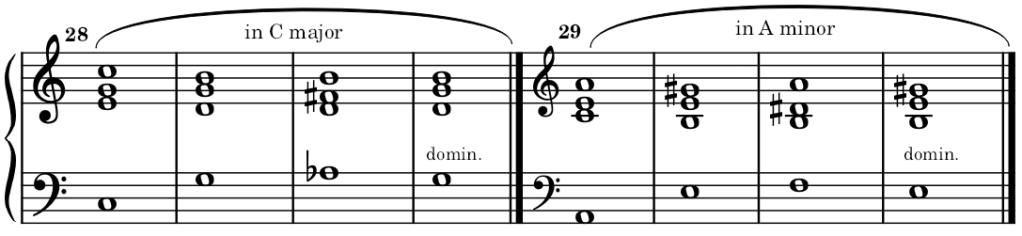
The same harmony unaltered
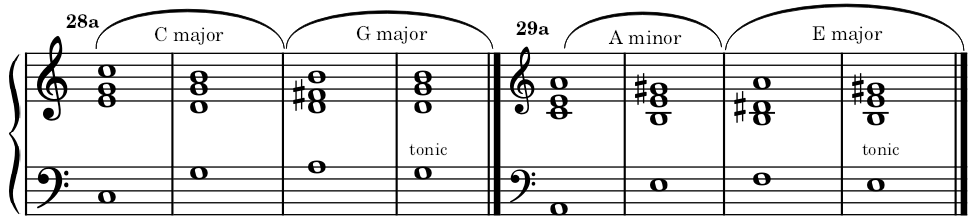
By first examining the unaltered examples (Ex. 28a and 29a), we see they modulate by a dominant seventh chord in second inversion, leading to the tonic of a new key. In the altered examples (Ex. 28 and 29), the modulation is nullified by the simple alteration, and each of these two examples stop on the dominant of the current key, even if the altered chord is foreign to the current key. This altered chord is borrowed from the key of the fifth above the current key, and is called the dominant of the true dominant (secondary dominant).
Summary
Chords with a diminished fifth are most often used in the second inversion, and are called augmented sixth chords. Thus any augmented sixth chord, must always been seen as having the alteration in the Bass, never in the other parts, with or without accidentals relative to the key.
Other Inversions of Chords with a Diminished Fifth
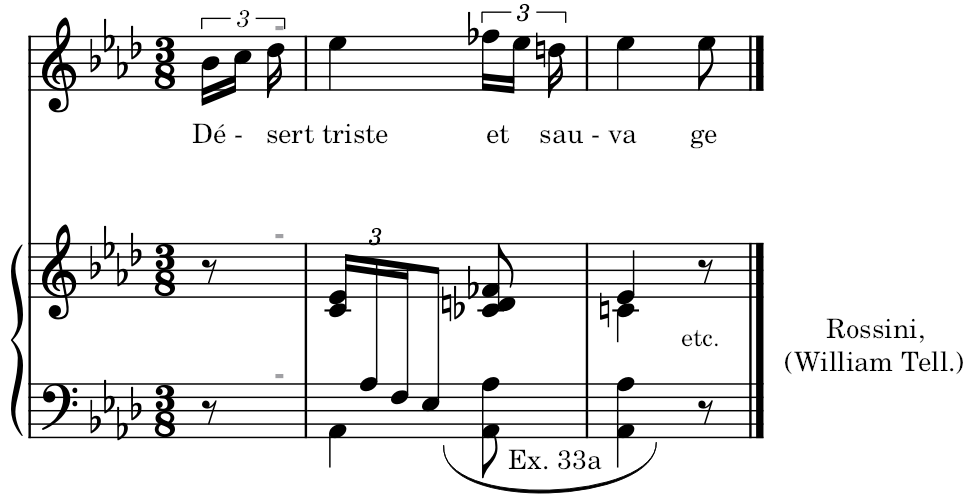
While the augmented sixth chord is the only one used in schools, various examples in the works of the most eminent composers attest to the excellent effect of this alteration in other inversions. Mainly the third inversion (Ex. 11, 14, and 22). The effect of the third inversion is mostly good in the exceptional resolution of Ex. 33. The diminished third, which necessarily results from the first inversion has been used successfully, especially in the conditions of Ex. 20. The next section of this article is particularly remarkable in 33a, where the diminished third, generally prohibited (Ch 17.1), is very harmonious.
Exceptional Resolutions
Some chords with a diminished fifth allow certain exceptional resolutions (Ch. 17.1) to have a very good effect. The most important and well known of these resolutions is for the augmented sixth chords, resolving on the tonic chord in the 2nd inversion (see Ex. 30, 30a, 31, 31a, 32, 32a, 34, 34a & 34b). The most common version is Ex. 32 and 32a.
Examples:

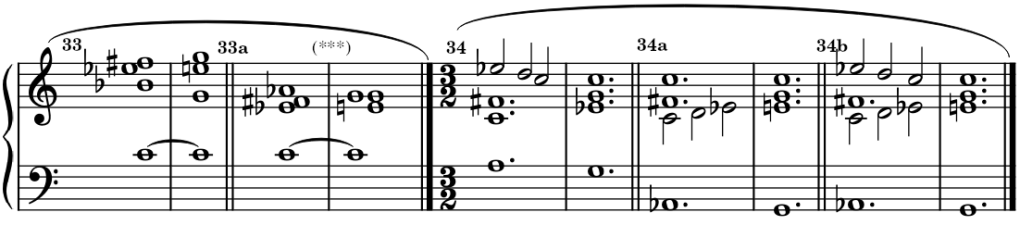


The following exceptions are sometimes found:

(***)
 Old Music Theory