
Ninth chords are only placed on 5th degree of the two modes. Thus, they are called dominant ninth chords. This results in two types of ninth chords:
1. Major Ninth Chord – composed of a dominant seventh chord with the addition of a major ninth. It’s placed on the 5th degree of the major scale.
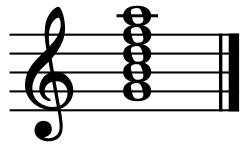
2. Minor Ninth Chord – composed of a dominant seventh chord with the addition of a minor ninth. It’s placed on the 5th degree of the minor scale.
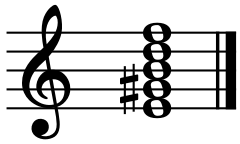
In four parts, both of these chords requires the suppression of one of its notes. As in all other chords, suppressing the fifth weakens the effect of the ninth chord as little as possible. Nevertheless, for reasons that will be appreciated through practice, the root is the most frequently suppressed, especially with the minor ninth chord.
The dissonant notes, the seventh and the ninth, requires no preparation. However, its best to prepare the seventh when its a common note with the previous chord (Ch. 14.1).
The ninth chord contains three notes with a constrained resolution. These are:
- the two dissonant notes which should conform to the rules of Ch 13.1,
- the third of the chord, or the leading tone of the key, see Ch. 14.1.
The resolution of the ninth chords follows the rules established Ch. 13.2.
The constrained resolution of the chords’ certain notes are subject to special conditions set out in the two special articles which deal with each of them.
The ninth chords, when heard in isolation, are the only chords which irreversibly determine both the mode and the key. Therefore, they are the two most complete chords of our harmonic system.
 Old Music Theory