
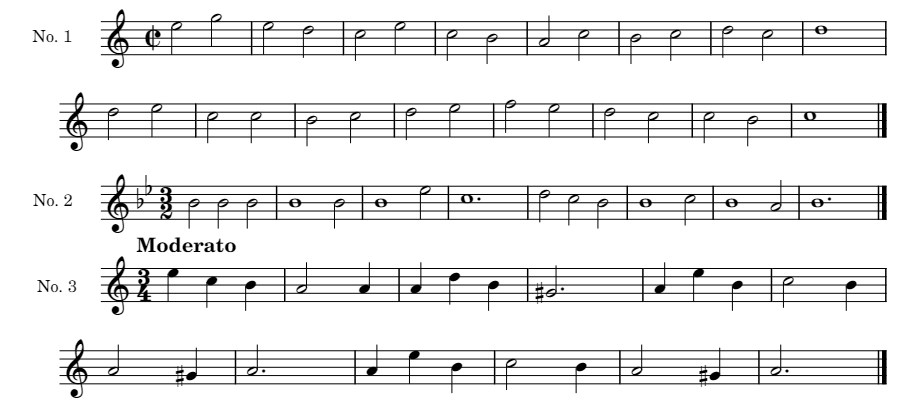
In exercises where you’re required to create harmony under a given melody, one must take care, before anything else, to be aware of the phrases and periods, as well as the different rests which separates members of a phrase. Only after finding suitable cadences to each rest period, that one will look for harmonic progressions applicable to each period.
The various chord inversions must now be used in these exercises. As much as the nature of each melody allows, change chord with each note, the main purpose of these exercises is to always be familiar to chord progressions with their inversions.
However, its evident that certain melodies, and even certain rhythms repeating the same note several times, doesn’t lend itself to constant chord changes. In these cases, its preferable to keep the same chord for two or several successive notes.
The student, must follow their instinct, except when comparing their work with the lessons of the appendix, conforming to the requirements given in “Exercises: Chord Progressions in Root Position” (Ch 4.)
Given melodies
 Old Music Theory