
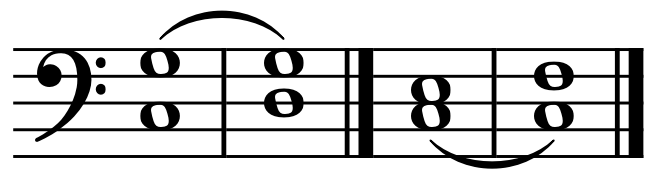
When a second inversion produces a perfect fourth between the Bass note and one of the upper parts, this fourth must be prepared by an oblique motion. Example:
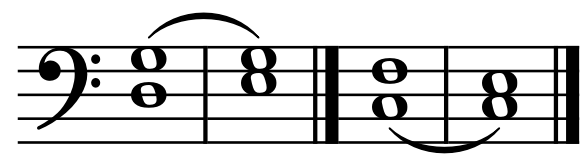
After which, in order to reach another chord, one of the two notes forming the fourth must also resolve by oblique motion. Example:
Based on these rules, there are only four ways to realize a fourth:
1. Fourth prepared and resolved by the Bass.
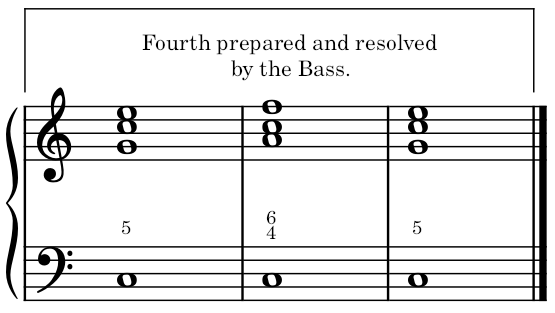
2. Fourth prepared and resolved by the upper/intermediate part.
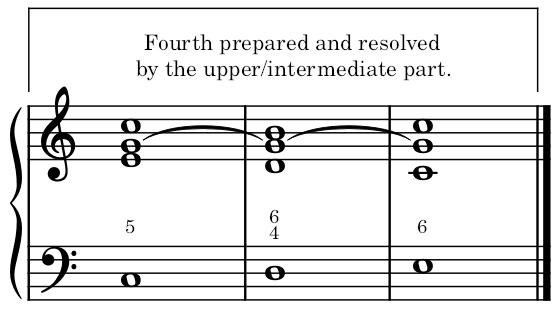
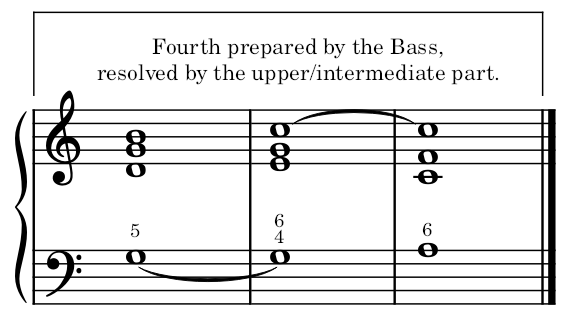
3. Fourth prepared by the Bass, resolved by the upper/intermediate part.
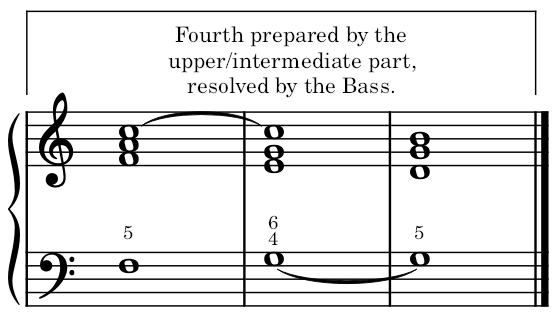
4. Fourth prepared by the upper/intermediate part, resolved by the Bass.
Note: The fourth between the upper/intermediate parts are not subject to this rule, as they’re considered consonances. It only applies when the fourth is formed with the Bass, and is classified as a dissonance.
The previous rule does not apply to diminished or augment fourths. It only applies to consonant and dissonant chords with a perfect fifth, since their second inversion results in the perfect fourth.
In the second inversion, the fifth, which is the Bass note, is preferably doubled. Example:
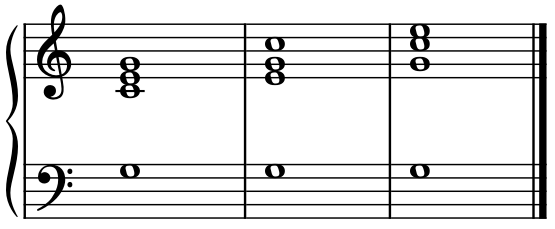
Doubling the root also has a good effect in cases analogous to the following:

Exception to Preparing the Fourth
The tonic chord (1st) in the second inversion doesn’t need the fourth to be prepared, especially when the chord is placed on the strong beat of the measure. Examples:

The particularity will be better appreciated in the Cadences chapter (9.)
This exception, which confirms the second inversion is harsh, makes it clear that any consonant chord, major or minor, in the second inversion without preparing the fourth imposes itself as the tonic chord, by provoking a tonal cadence discussed in the Cadences chapter. Thus, when the fourth is not prepared in the second inversion of a chord that isn’t the current tonic chord, it results in the impression of a new tonic, and thus, a modulation.
Thus, an unprepared second inversion can be used to modulate. But if this is not consciously utilized for that purpose, if its place in the phrase doesn’t permit a satisfactory cadence, if its only the product of ignorance or an oddity, then its effect will always be bad.
This is why preparing the fourth is required for any chord in the second inversion other than the tonic chord. This is one of the most important laws in musical composition.
Exceptions to Resolving the Fourth
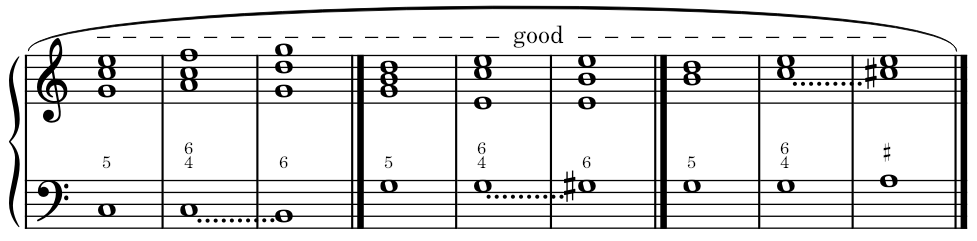
1. The fourth can be resolved by moving one of the notes a semitone up or down, diatonic or chromatic. (chromatic necessarily implies a modulation.) Example:
2. The tonic chord in the second inversion sometimes ignores resolving the fourth, but this exception is only practiced in the following progression. Example:
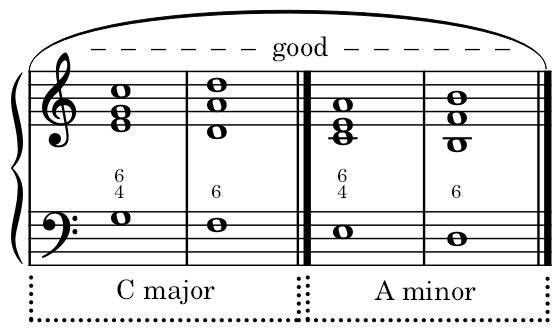
3. The fourth can be prepared or resolved when one of the notes switching octaves instead of remaining in place. This exception is mostly done in the Bass. Example:
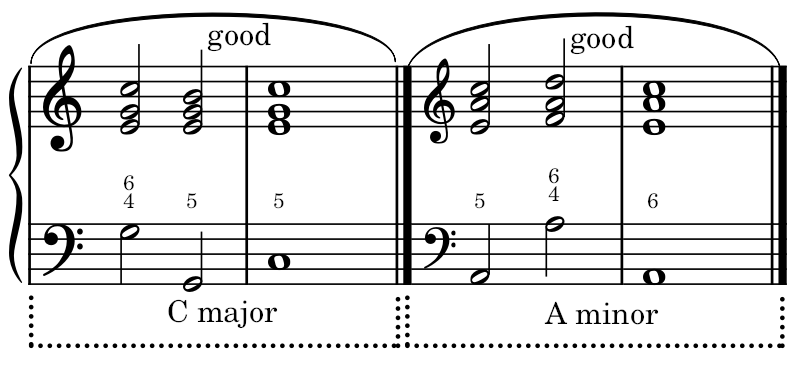
Since the fourth needs to be prepared and resolved, two second inversions can only be connected when the fourth of the latter chord moves up. Example:
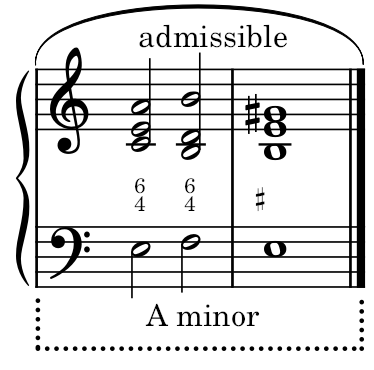
In this case, the fourth of the first chord is resolved by a semitone, and the second chord contains an augmented fourth, which doesn’t need to be prepared.
Exception within the Same Chord
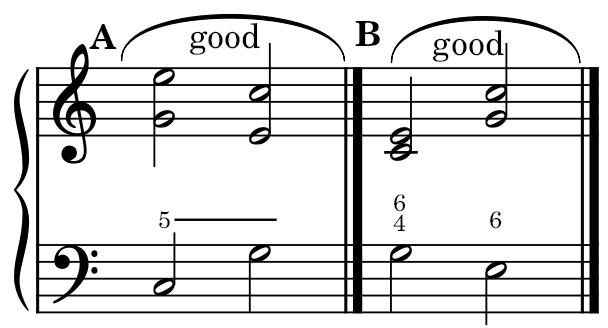
- The fourth doesn’t need to be prepared when the second inversion is preceded by another position of the same chord. (Ex. A)
- The fourth doesn’t need to be resolved when its followed by another position of the same chord. (Ex. B)
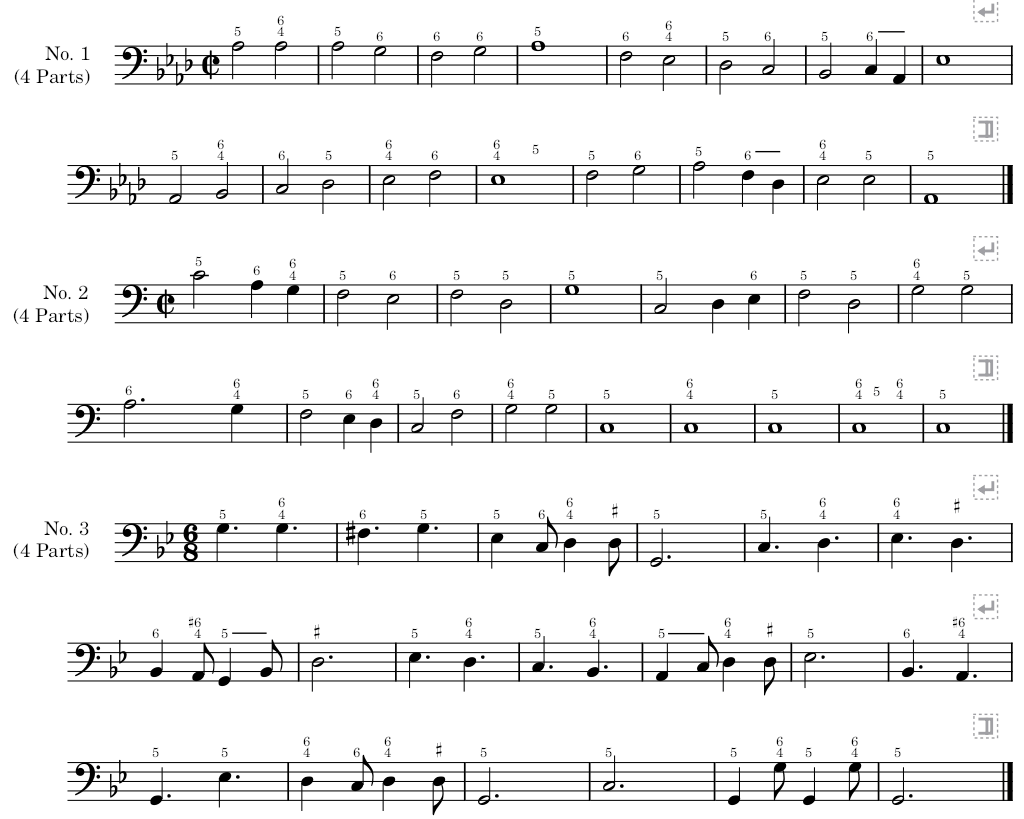
Basses to realize
 Old Music Theory