
Note: The student can study this chapter immediately. This chapter is enough to allow the student to realize any new figures encountered in the Basses for realization exercises.
To indicate as briefly as possible harmony to be realized, one uses number placed above the notes of the Bass. Each Bass note receives one or more figures, according to necessity, and according to the nature of the chord to employ. When there isn’t enough space between the staves, the numbers can be placed underneath.
The numbers indicate the intervals of the important notes of the chord relative to the Bass note. They are only a means of guiding the harmony, often incomplete and insufficient, and which many authors have more or less modified according to their convenience. Some authors express all notes in the figures, others only put the most indispensable figures for making guesses.
Thus, the triad (“perfect chord“), in its root position, is most often expressed by 5, sometimes 5 3, other times only 3 which, in this case, often implies the suppression of the fifth.
The number 8 usually imposes the octave.
The diminished fifth chord is also 5, often a barred 5 (5).
The zero indicates a unison, sometimes the octave, and in any case the absence of harmony.
When the triad is in the root position, it is sometimes drawn without a number. Thus, the absence of figures implies the triad (perfect chord.)
When several numbers are needed to express a chord, these figures are written based on their order ranked from the weakest at the bottom to the strongest at the top. Unless, we intend to specify the position of the chord, in which case we write the numbers according to their position from bottom to top. Example:

When a note held in the Bass is common to various consecutive chords, each chord is successively indicated with figures, leaving sufficient space between the numbers or columns of figures for each chord. Example:

Thus, the C note has 3 chords. This manner of indication is vague since the duration of each chord is unspecified. In that case, we give equal value to all the chords when the subdivision of the measure allows it, else we conform to the general rhythm of the piece.
A horizontal line immediately after a number indicates the note represented by that number extends as far as the line, even if other figures place above or below that line changes the nature of the chord. Examples:

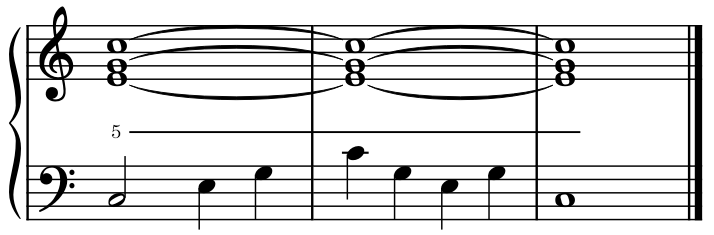
Therefore, the horizontal line also serves to indicate the chord be held, and ignoring movements of the Bass that implies a chord inversion. Example:
An accidental placed next to a number affects the corresponding note. Example:

indicates F Sharp:
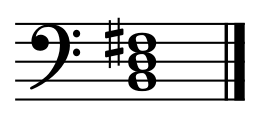
An isolated accidental affects the third, as if it was figured ♯3. Example:
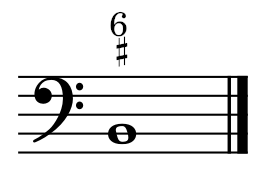
and
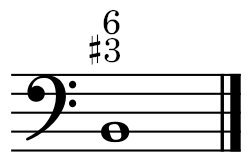
represents

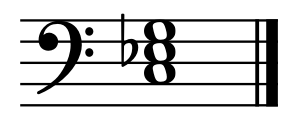
For the triad in root position, its enough to place the accidental alone above the root. Example:
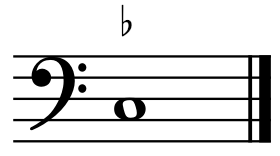
and

represents
A small cross, +, in all dominant dissonant chords, generally indicates the a number is the leading tone.
 Old Music Theory