
The division of the measure implies a rhythm which may influence the effect of chord and sometimes the realization of chords.
The strong beats of the measure are those which attract the main accent. These are:
- 1st and 3rd beats of the four-beat measure
- 1st beat in two beat measure
- 1st beat in three beat measure
All other beats are weak beats. The strong or weak beats of compound measures are the same as those of the simple measure they are derived from.
In the four-beat measure, the 3rd beat is weaker than the 1st.
In the three-beat measure, certain rhythms may include a second beat on the 2nd or 3rd beat, depending on the character of the rhythm and place of the accent.
In slow movements which contain a large subdivision of the measure, and mainly in composite measures, the first note of each beat is strong relative to the other notes in the same beat, but the main beats are always important.
The strong or weak beats greatly influence the harmonic and tonal importance of a chord as well as its progression. The strong beats prefer the good degrees, imparting greater tonal strength. Bad degrees are better on weak beats. So, in the following example:
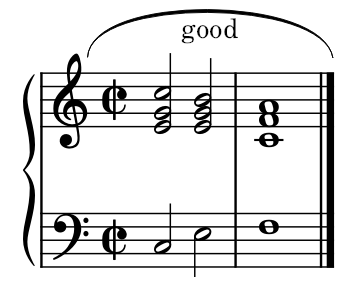
The mediant chord (3rd), brought by a weak progression, has a good effect because its placed on a weak beat, and it only serves to transition to the subdominant chord (4th).
While in the following example:

The weak tonality of the mediant chord (3rd) is more evident because of its placement on the strong beat of the measure. This explains why, when alternating complete and incomplete chords, the latter are preferably on weak beats to reserve the strong beats for complete chords.
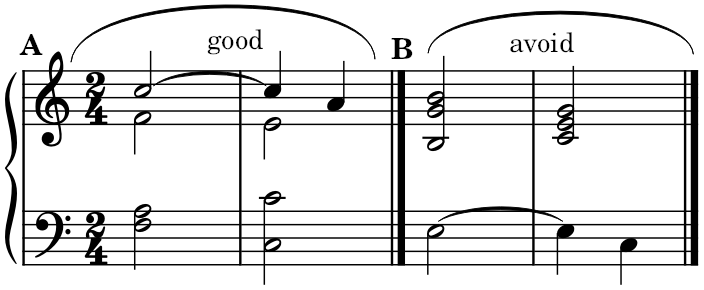
The strong and weak beats often influence chord realizations. Strong beats are always much better marked by bass movement rather than by the movement of another part while the bass remains motionless. For this reason, the delayed octave of (Ex. A) is not faulty, while Ex. B must be avoided because the Bass, not placed on the strong beat, gives the sensation of a delay, and consequently, parallel octaves.

The same is true of delayed fifths. Examples:
 Old Music Theory