
When changing the position without changing the chord, melodic intervals of a major sixth, diminished fifth, minor seventh, and diminished seventh are tolerated in the predominant parts. This is an EXCEPTION to Rule 1 of Part Motion (2.6.)
As long as the same chord lasts, the various position changes can lead directly to the perfect fifth or octave/unison. This is an EXCEPTION to Rule 4 of Part Motion (2.6.) Examples:

Position changes may affect the realization of the proceeding chord in various ways, as will be seen below.
SUPPLEMENTARY RULES CONCERNING HARMONIC FIFTHS AND OCTAVES
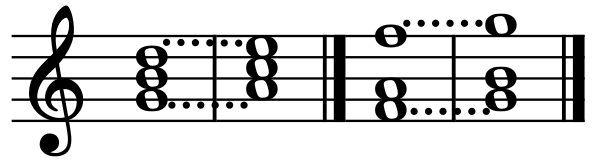
A correct realization (Ex. 1 and 2) can become faulty by a position change in the first chord by one of the parts (Ex. 1a and 2a.)
Ex. 1a creates the effect of 2 perfect fifths, and Ex. 2a creates the effect of two octaves. However, this effect is only temporary, and the part that changes position returns to the original position before the second chord is played.

If one has reasons to preserve the melodic movement of Ex. 1a and 2a, the two parts of the fault must change position so that they are never a fifth apart before reaching another fifth (Ex. 3) or an octave apart before reaching another octave (Ex. 4.)
The bad effect of two fifths or two octaves:
cannot be avoided by a simple position change of the first chord.
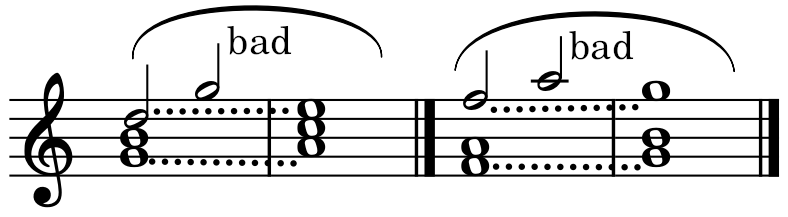
This is because the impression of the first position is not erased by a position change.
Any number of consecutive position changes does not destroy the impression of the first position. Example:
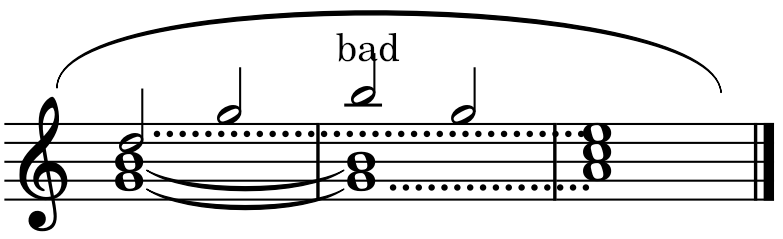
Note: Unless a later position has a sufficient duration to forget the first position.
The previous considerations also concern part crossings during the same chord. Example:
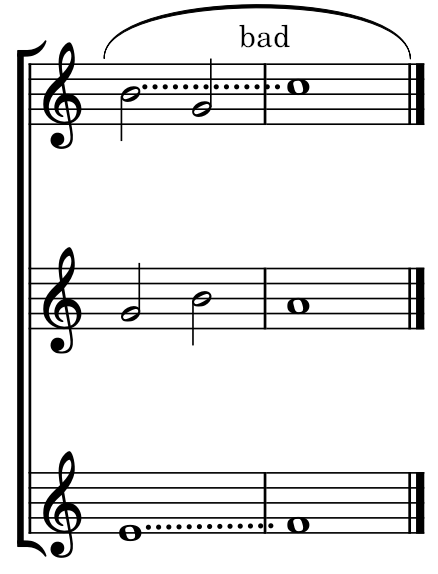
Effect:
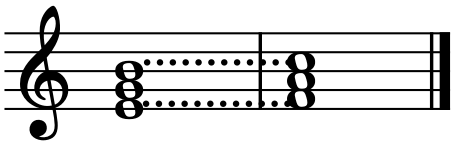
If the fifth or octave in the next chord results from an oblique movement, there is no fault (Ex. 5 and 6) as long as the syncopated note has sufficient time for the oblique movement to be perfectly appreciated. Thus Ex. 5 and 6 would be less good as the tempo increases. Ex. 5a and 6a are always faulty because the sensation of the oblique movement is null or incomplete. Similar realizations are called anticipated fifths and anticipated octaves.

For a single perfect fifth or octave from a direct movement, one must comply with the following instructions.
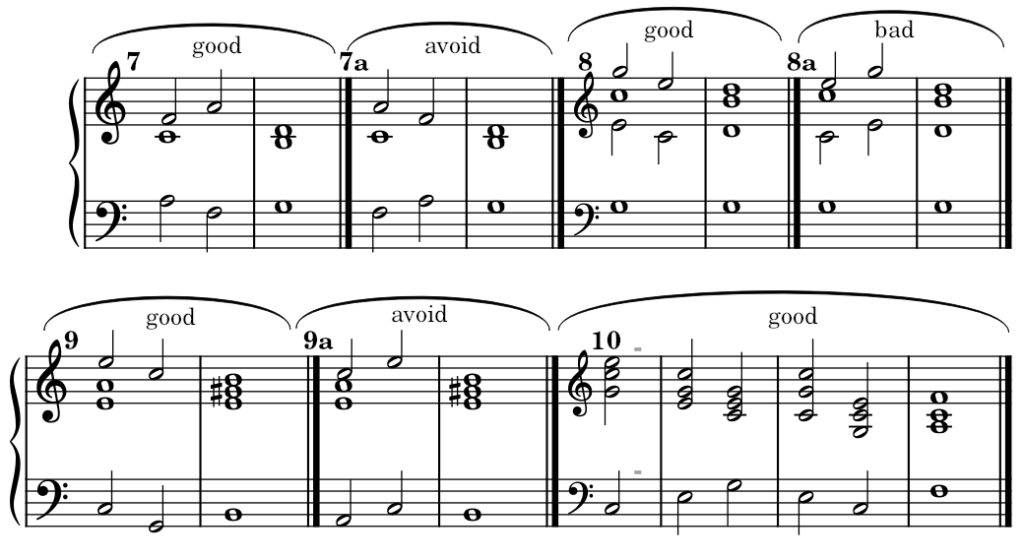
1. When two parts end in a perfect fifth or an octave simultaneously change position, either by contrary (Ex. 7 and 7a) or similar (Ex. 8, 8a, 9, and 9a) motion, the last position before the chord change is the only position which affects the realization of the next chord, regardless of the previous positions (Ex. 10.) Examples:
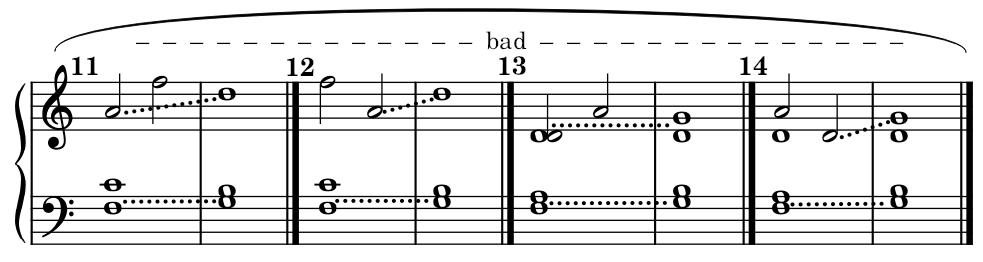
2. If the position change of the first chord only occurs in one of the two parts which results in a perfect fifth or octave, and the other two parts remain motionless (Ex. 11, 12, 13, 14), then both positions affect the realization of the next chord.
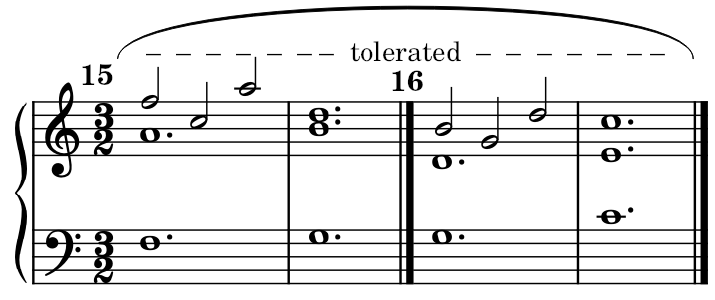
The intermediate parts result in no faults in most cases (Ex. 15 and 16.)
However, cases where the last position is identical to the first (Ex. 17, 18, and 19) are excepted from the previous rule. In this case, the last 2 positions affect the realization of the next chord. But realizations similar to Ex. 19a, 3, and 4 are the best in most cases.
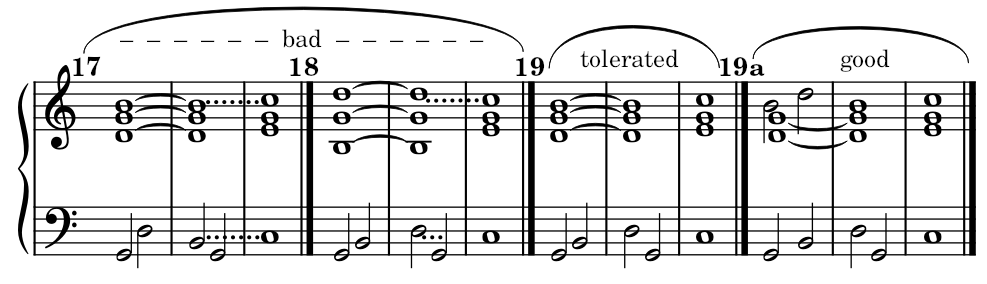
Note: The rules and observations contained in this article are generally confirmed by practice in the works of the most eminent composers. But experience and instinct are often the best guides in this respect, As the placement of a position in a measure, and the duration of each chord position greatly influences the realization of the next chord.
The following reflections mainly concern the Rule 2 of a single perfect fifth or octave from a direct movement (listed above). The pupil must strictly follow this rule. Thus, realizations similar to Ex. 11 and 13 are prohibited in study (or at school), although their effect is not always bad. Firstly, because a single perfect fifth or octave is already better than parallel fifths or octaves. Secondly, because the position changes in Ex. 11 and 13 somewhat reduce the effect of the direct fifth and octave.
Some authors do not strictly follow these exceptions, others avoid them. They are therefore subject to the appreciation of each. In any case, its preferable not to involve the two outer parts (see Supplementary Chapter Article 2.)
Lastly, what most permits these exceptions is that the fifth or octave is part of a chord of one of the good degrees.
In summary, the supplementary rules concerning harmonic fifths and octaves are further supplemented by the Duration of Chord Positions and Silences (5.5.)
Delayed Fifths and Octaves
Delayed fifths or delayed octaves occur when one of the two chords in a realization undergo a position change resulting in a fifth or an octave between the extreme parts. Aside from this case, generally, modifying the second chord does not result in any inconvenience in realization. However, some authors consider delayed fifths and octaves as bad. Examples:
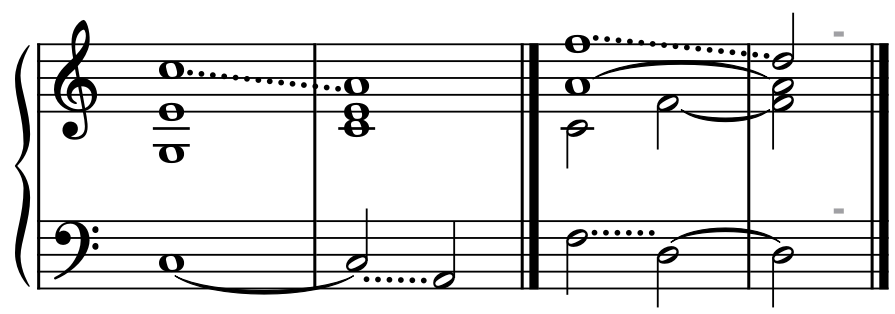
The previous resolutions are loose ends, as if there were two parallel octaves. Examples:

Similar cases are more subject to instinct and taste as they depend on the duration of the notes and especially on the influence of strong and weak beats, as will be see in Chord Placement in the Measure (5.3.)
The same observations apply to delayed fifths. Example:
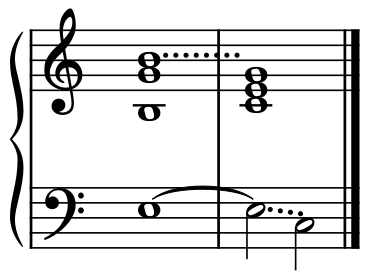
Delayed fifths have a less bad effect and are much more tolerated, even by the strictest authors, compared to delayed octaves.
 Old Music Theory