
A phrase where the key is already determined, may contain a chord or even several foreign chords that don’t destroy the tonal impression. Examples:
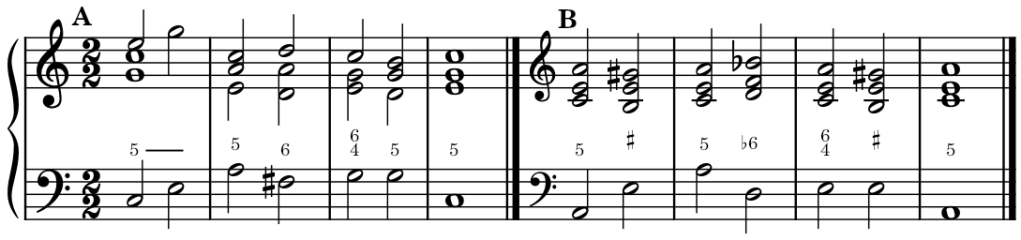
Ex. A is in C major, despite the F#, which can be substituted whenever with a F natural.
Ex. B is in A minor, despite the B♭ which can be substituted for B natural.
These foreign chords can be considered in two ways:
- They are an alteration of one or more notes of a chord, or
- They are borrowed from foreign keys, with no intention to modulate, used only for variety and adding surprise into the harmony.
These are called Borrowed Chords, because the term alteration/altered will be assigned to a special class of chords (Book 1, Part 2, Chapter V.)
Thus, in Ex. A, the chord containing an F is borrowed from the key of G major.
In Ex. B, the chord B♭ is borrowed from the key of F major.
Remark: The major mode can borrow more chords and more frequently from its parallel minor than the minor mode can from its parallel major. Borrowing chords from the parallel major in the minor mode often has bad effects. Example:
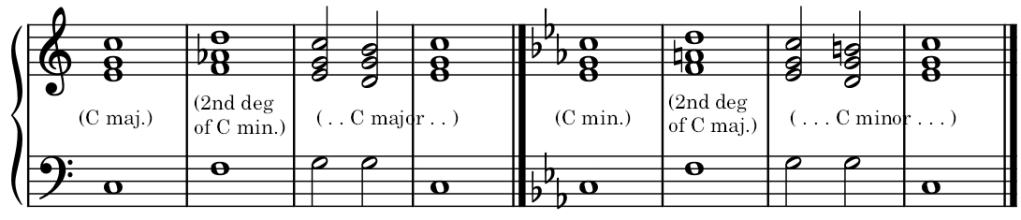
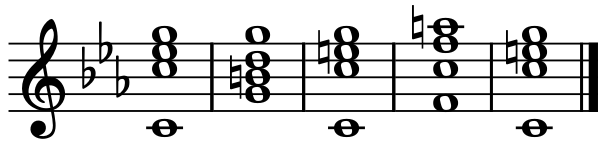
This peculiarity will have more examples in the section on dissonant chords. Since the minor mode is less perfect than the major mode (see Introduction for details), in the minor mode, once a chord from the parallel major (mainly the 4th degree) is heard, a modulation to the parallel major becomes necessary. Example:
While the major mode isn’t as disturbed by chords borrowed from its parallel minor. Examples:
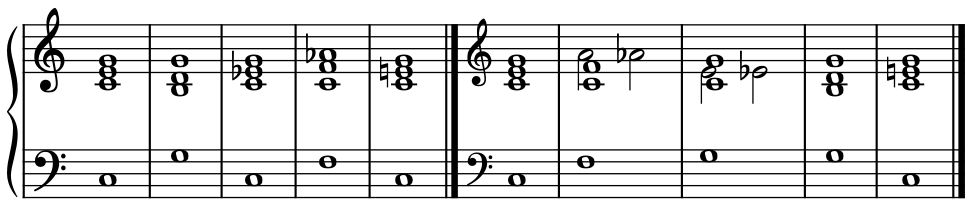
Regarding the minor mode, in order to borrow chords while avoiding a modulation, these chords must be borrowed from its relative keys.
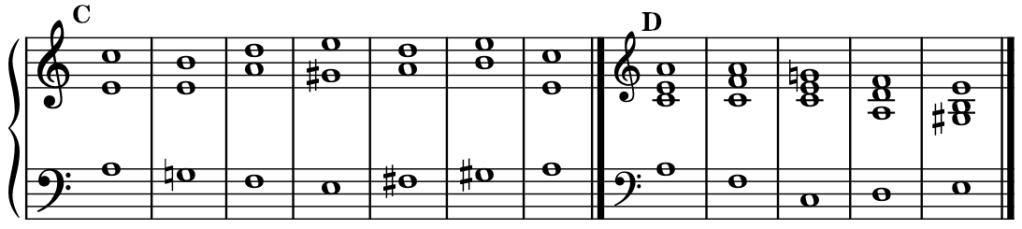
In the minor mode, these borrows are frequent when a number of different chords are linked together. Thus, one chord necessarily leads to a borrowed chord, either to:
- avoid the melodic interval of an augmented second from the 6th to the 7th/7th to the 6th degree in the minor mode (Ex. C), or
- because the chord of the 3rd degree is impracticable (Ex. D.)
 Old Music Theory