
Triads are composed of the root, third, and fifth. They form the essential and indispensable component of harmony.
The old masters, until the end of the 16th century, only used triads with some techniques of composition.
Its essential that the student study and practice these chords exclusively until they are familiar with their effects and all the resources they offer. This study will lead them to understand, appreciate, and better utilize all the other chords.
Types of Triads
By forming a triad on each degree of the two modes, and by classifying each of these chords according to the nature of their intervals that compose them, the various species are the following:
Comparison table
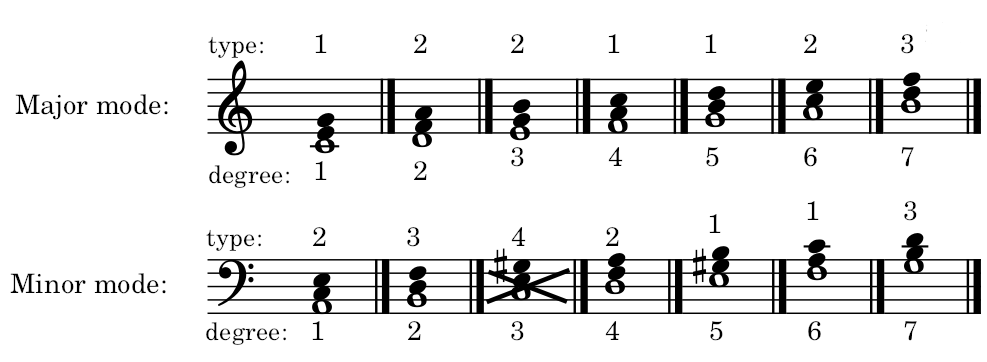
(Refer to the table above as you read the following text.)
- major chord is a chord with a major third and a perfect fifth. Its placed on the 1st, 4th and 5th degree of the major mode, and the 5th and 6th degree of the minor mode.
- minor chord is a chord with a minor third and a perfect fifth. Its placed on the 2nd, 3rd, and 6th degree of the major mode, and the 1st and 4th degree of the minor mode.
- diminished chord is a chord with a minor third and a diminished fifth. Its placed on the 7th degree of the major mode, and the 2nd and 7th degree of the minor mode.
- augmented chord is a chord with a major third and an augmented fifth. Its placed on the 3rd degree of the minor scale (slightly crossed out.) While this type of triad often appears in composition, it hardly appears as the 3rd degree of the minor mode. Proof of this will be provided in later chapters. For now, this chord will be considered impracticable since it does not exist in the major mode, and as a rule, the 3rd degree of the minor mode cannot serve as the root of any chord in this mode.
Remark: The major and minor chords are the only consonant chords, and thus they are called perfect chords. All chords consisting of more than 3 notes are dissonant. As for the diminished chord, while its diminished fifth is dissonant, its not truly considered a dissonant chord because its not governed by the same rules as actual dissonant chord. Rather, its an imperfect chord. Its sometimes called a mixed chord or a neutral chord. In summary, it will be used under the same conditions as the perfect chords. For this reason, all triads are defined as consonant chords.
 Old Music Theory